marine link image
Register now for the Port of the Future Conference • 2 Days, 50 Ports • Houston/Galveston area, TX • April 12–14, 2027

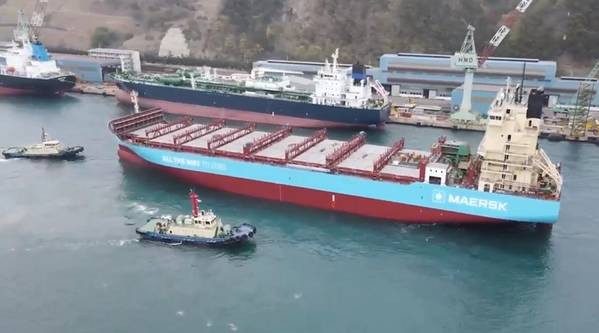
World’s First Methanol-Fueled Containership Launched

April 20, 2023

(Photo: A.P. Moller - Maersk)

The world’s first methanol-fueled containership has been launched for A.P. Moller - Maersk as the Danish shipping giant makes headway toward its goal to decarbonize its operations.

“The launching was successfully completed on April 4 at Hyundai Mipo Dockyard, and the construction is continuing with delivery in the summer,” said Henrik Ekmann, Head of Newbuilding & Retrofit at Maersk.

The 2,100 TEU, ABS-classed class feeder vessel features dual fuel main and auxiliary engines built by MAN Energy Solutions that are able to operate on green methanol.

The use of methanol as marine fuel emits fewer NOx emissions and no SOx, and methanol synthesized from carbon dioxide and hydrogen can achieve CO2-neutral combustion.

Maersk plans to put into service 19 vessels capable of running on e-methanol between 2023 and 2025 as part of its net-zero emissions target by 2040. According to Maersk, these vessels will generate annual CO2 emissions savings of around 2.3 million tonnes when deployed to replace older vessels.


Logistics News

A Ceasefire Would Allow Russia to Restart 80% of Black Sea Grain Export Terminals

A Ceasefire Would Allow Russia to Restart 80% of Black Sea Grain Export Terminals

Aderco's 2055G+: Emissions Performance with Shared, Verifiable Data

Aderco's 2055G+: Emissions Performance with Shared, Verifiable Data

ARC Freedom Enters ARC's U.S.-Flagged Fleet

ARC Freedom Enters ARC's U.S.-Flagged Fleet

NYK Contributes to Industry Insight on Ammonia-Fueled Vessels at IMO

NYK Contributes to Industry Insight on Ammonia-Fueled Vessels at IMO

Subscribe for Maritime Logistics Professional E‑News

US: New air traffic control system won't cause disruptions
US wants to spend another $30 billion on aviation systems
Sources say that traders are pushing for lower prices for Venezuelan crude oil, as shipping costs have risen.