POLB Solicits Proposals For Zero-Emissions Technology
Posted by Michelle Howard
July 28, 2017
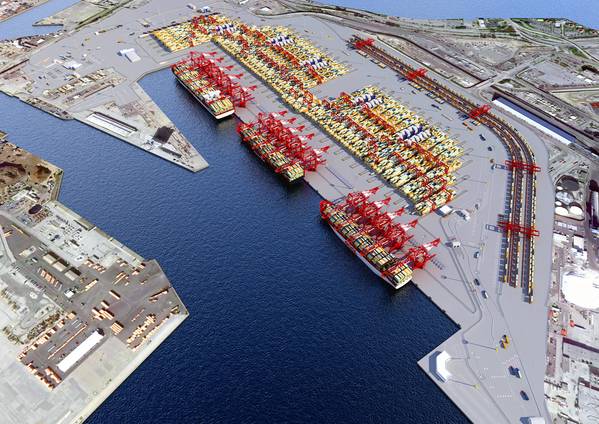
File Image: Port of Long Beach middle harbor rendering (CREDIT POLB)
The Port of Long Beach, in partnership with the Port of Los Angeles, has released a request for proposals seeking demonstrations of technologies to upgrade tugboats, crew boats, barges and other harbor craft to cleaner engines.
Harbor craft are the second-largest source of diesel particulate matter air pollution in San Pedro Bay, comprising 18 percent of the emissions. The vessels also contribute 10 percent of nitrogen oxide and 6 percent of greenhouse gas pollution. Under state regulations, most of the boats have engines meeting Tier 2 emission level standards.
“We are looking at ways to reduce emissions from harbor craft beyond existing regulatory requirements,” said Port of Long Beach Director of Environmental Planning Heather Tomley. “We need more viable cost effective technologies, and as the Green Port, we’re going to leverage all of our tools to lead the goods movement industry to a more sustainable future.”
The request by the ports under the Technology Advancement Program offers $500,000 ($250,000 from each port) for one or two demonstrations of technologies that will upgrade engines to Tier 3 or Tier 4 standards — making engines up to 70 percent cleaner. Proposals are due by Thursday, Sept. 21.
Reducing emissions from harbor craft is a key strategy in the recently released draft Clean Air Action Plan (CAAP) update, developed with input during more than 50 public meetings. The Harbor Commissions of both ports are expected to meet in November to consider the final draft.
The CAAP, adopted in 2006, is a landmark effort aimed at reducing the health risks posed by port-related air pollution from ships, locomotives, trucks, terminal equipment and harbor craft. Compared to 2005 levels, the CAAP has helped reduce diesel particulate matter up to 85 percent, cut nitrogen oxides in half, eliminated 97 percent of sulfur oxides, and shrunk greenhouse gases an average of 12 percent.