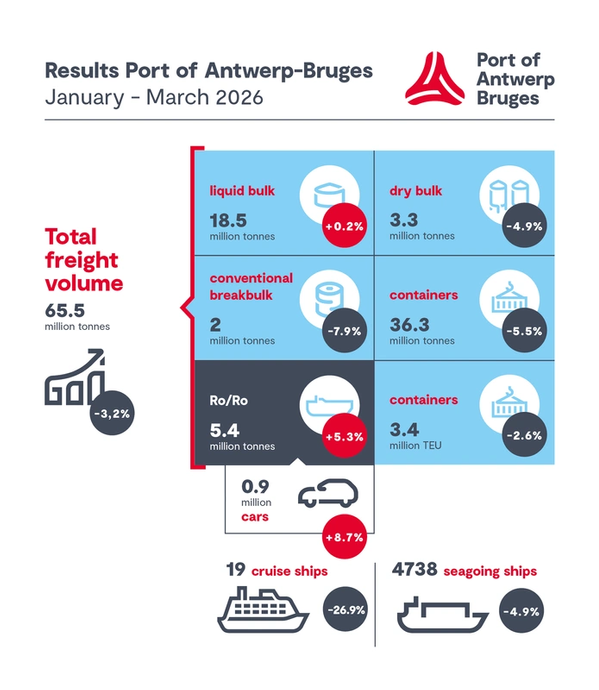
In the first quarter of 2026, Port of Antwerp‑Bruges handled 65.5 million tons of maritime cargo, a decrease of 3.2% compared to the same period last year.
After a weak start in January and February, throughput recovered in March. General cargo (-4.4%) – in particular containers and conventional general cargo – was under pressure, while bulk cargo remained stable (-0.6%) and RoRo traffic increased.
The port says the results reflect a complex combination of factors, including adverse weather conditions, social actions, geopolitical tensions and a weakened European industrial base.
Total cargo throughput was down 2% in Q1 2026, as container traffic impacted by weather disruptions, strike action and weak export performance.
The first effects of the Middle East conflict also became visible.
Weaker start for container traffic
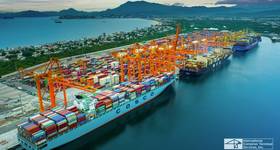
In the first quarter of 2026, container throughput decreased by 5.5% in tons and 2.6% in TEU compared to the same period last year. The port says this should be seen against the backdrop of a relatively strong start to 2025, when the restructuring of container alliances generated high inbound volumes, as well as the weakened export position of Western Europe.
In addition, the start of the year was marked by extreme weather conditions. A snowstorm and prolonged cold spell in January, followed by severe storms in the Bay of Biscay until mid‑February, disrupted shipping and terminal operations.
A four‑day strike against pension reform also had a significant impact. The interruption of the nautical chain led to the diversion of several vessels to other ports and to planned call-sizes that could only be partially handled due to a lack of spare terminal capacity.
Overall, an estimated 100,000 TEU (approximately 1.1 million ton) of container throughput was lost. From mid‑February onwards, and particularly in March, volumes recovered, once again highlighting the need for additional container handling capacity.
Mixed performance in other segments
Conventional general cargo was also under pressure, mainly due to lower steel exports to key markets such as the United States, Mexico and Canada, as well as the entry into force of the Carbon Border Adjustment Mechanism (CBAM) on 1 January 2026.
By contrast, the RoRo segment recorded growth, driven by higher volumes of new vehicles and high and heavy equipment. Shortsea RoRo traffic remains affected by the EU Emissions Trading System (ETS), particularly on longer hauls, although the shift towards road transport appears to be slowing as diesel prices rise.
Dry bulk declined by 4.9%, due among other things to lower fertiliser volumes and the disappearance of coal traffic. Liquid bulk recorded slight growth of 0.2%, supported by a strong performance in March. However, developments within the segment varied widely: volumes increased for gasoline, naphtha, fuel oil and LNG, while diesel, kerosene and LPG declined.
These trends are influenced by changing market conditions, shifts in feedstock, anticipation of the European import ban on Russian LNG, as well as geopolitical tensions and market dynamics such as backwardation. Chemicals throughput remains under pressure due to the weak position of the European chemical industry.
First impact of the Middle East conflict
The direct impact of the conflict in the Middle East remained limited in the first quarter due to longer sailing times via the Cape of Good Hope. The decline in imports from and exports to and from the Persian Gulf, of respectively 12% and 49%, during this period can largely be attributed to weather‑related disruptions.
From the end of March onwards, however, the first effects became visible. On 23 March, the last LNG tanker so far from Qatar arrived in Zeebrugge, and container lines adjusted their sailing schedules towards alternative ports in the Middle East and the eastern Mediterranean.
At present, the most significant impact of the conflict and the blockade of the Strait of Hormuz is indirect, through rising energy and fuel prices. These increased bunker and transport costs and further weaken the competitiveness of European industry. At the same time, low European gas storage levels – which will need to be replenished ahead of next winter – and disruptions in supply chains for certain products are creating additional uncertainty and inflationary pressure.
Investments and projects reinforce future‑oriented strategy
Despite geopolitical tensions and economic pressure, Port of Antwerp‑Bruges continues to invest in its future. The arrival of Chinese manufacturer Windrose, which is developing its first European flagship site for electric trucks in Antwerp, confirms the port’s international appeal for innovative and sustainable investments.
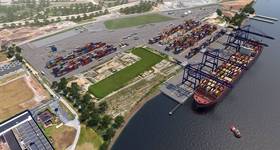
At the same time, operational capacity is being reinforced through the modernisation of the Europa Terminal, where newly delivered crane infrastructure will play a key role in handling the world’s largest container vessels. With the launch of market assessment for the ECA project, Port of Antwerp‑Bruges is also taking the next step towards additional container handling capacity, with the ambition of supporting future growth in a sustainable and resilient manner.
During the European Industry Summit in Antwerp, the port endorsed the Antwerp Call to Alden Biesen, a clear appeal for a stronger European industrial policy, focusing on competitive energy prices, fair trade conditions, protection against carbon leakage and recognition of the chemical sector as a cornerstone of European industry.
Johan Klaps, Chairman of the Board of Directors of Port of Antwerp‑Bruges and Antwerp Alderman for the Port, said: “What we are witnessing is not a temporary fluctuation but a structural challenge for the European economy. High energy costs, geopolitical uncertainty and an uneven international playing field are putting pressure on our competitiveness. If we want to safeguard our strategic autonomy and prosperity, Europe must act faster and more decisively. Port of Antwerp‑Bruges is not a spectator in this process, but an active partner helping to shape solutions.”