Copenhagen Atomics has successfully completed two years of continuous operation of a molten salt pump and test loop at its facilities in Copenhagen. The system has been running without issues under high-temperature molten salt conditions, marking one of the longest continuous durability tests of its kind worldwide.
Molten salt reactors rely on pumps to circulate liquid fuel or coolant at temperatures exceeding 600 °C for years at a time. Demonstrating long-term, stable pump operation is therefore a prerequisite for regulatory approval and commercial deployment.
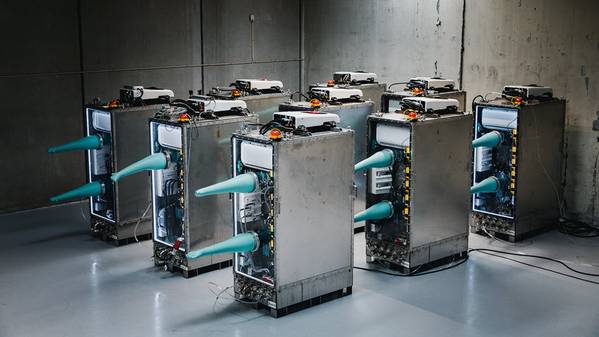
The pump is part of Copenhagen Atomics’ pumped molten salt loop platform, a fully integrated test system designed to replicate the thermal, chemical and mechanical conditions found in future reactors, but without nuclear fission. Across the company’s test infrastructure, Copenhagen Atomics has now accumulated more than 100,000 hours of combined pump runtime, and many pumps have exceeded one year of runtime.
Copenhagen Atomics is developing a fundamentally different type of nuclear reactor based on a molten-salt system with a unique fuel logic. Unlike conventional reactors, which rely on repeated refueling with fissile material, Copenhagen Atomics’ reactors are designed to operate long-term while being refueled only with fertile material such as thorium. The same fuel salt remains in the reactor for decades, while new fissile fuel is continuously bred from a separate blanket.
This enables the use of nearly all the energy potential in the raw material, radically changes waste characteristics, and underpins a path to lower costs and scalable deployment. Because of this structural difference, Copenhagen Atomics does not fit into traditional labels such as SMR or Gen IV.
“This is exactly the kind of milestone molten salt technology needs”, said Professor Emeritus Niels J. Bjerrum. “For decades, molten salt reactors have been discussed as a promising next-generation nuclear solution, but progress depends on proving that key components can operate reliably over years, not weeks. Demonstrating continuous pump operation under realistic molten salt conditions for two full years is a major technical validation and an important step toward commercial and regulatory readiness.”
“Component reliability is not something you prove once, it has to be proven repeatedly over long periods and under realistic conditions,” said Thomas Jam Pedersen, CEO and co-founder of Copenhagen Atomics. “Running a molten salt pump continuously for two years is a major technical milestone, and it confirms that our approach to design, materials, salt purity and testing works as intended.”
Unlike many reactor developers, Copenhagen Atomics designs and builds its pumps, control electronics, sensors and test loops in-house, and produces highly purified molten salts at tonne scale. This vertically integrated approach allows the company to run long-duration tests at a fraction of the cost typically seen at national laboratories or large research facilities.
While molten salt reactors have been studied for decades, the global industry has accumulated very limited operational experience. Fewer than a handful of molten salt reactors have ever operated, and for only short periods. This lack of historical data increases regulatory requirements for component testing.
Copenhagen Atomics plans to continue expanding its test capacity over the coming years, with the long-term goal of operating dozens of molten salt loops in parallel, both in Copenhagen and with partner institutions.