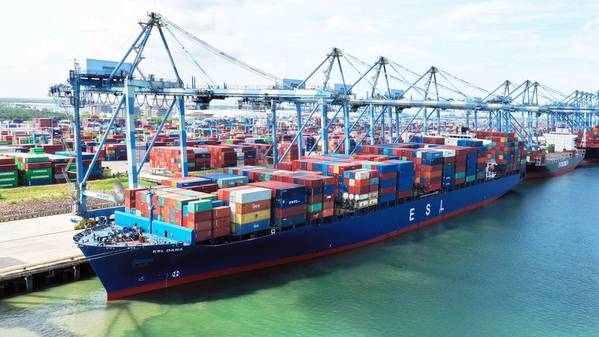
Emirates Shipping Line (ESL) reports that it has cut 20% emissions on 75% of its fleet using a multi-prong approach of equipment technology and operational technique.
A central aspect of the program involved a re-design of ESL’s vessels' propellers. In collaboration with designers from Mecklenburger Metallguss GmbH (MMG), ESL and the Peter Döhle group jointly developed and installed upgraded propellers on each ship. The use of these propellers reportedly yielded a significant improvement in overall flow and efficiency. Carbon emissions have been reduced by up to 10% from the propeller renewals, as confirmed by computational fluid dynamics (CFD) and large-scale measurements.
In addition, to minimize emissions associated with using typical paints such as copper-based ones, ESL made the switch to silicon-based paints. These are verified to average an 8% reduction in fuel consumption across the tested ships’ speed profiles. More durable and less detrimental to the environment, these paints reduce the drag of ESL’s ships and further reduce greenhouse gas emissions by improving fuel efficiency.
On top of physical changes to ESL’s ships, enhanced operational procedures have also been streamlined, focused on optimal routings based on real time weather data, better planning of the ships and trim optimization. With these measures in place, carbon emissions have been further reduced by 2%, contributing to the overall 20% decrease.
To stay on track with sustainability goals, the company monitors its vessels’ operations and carbon footprint through the continued use of Vessel Optimization AI Technology, a centralized technology platform that allows the tracking and improvement of fleet performance and efficiency. At the end of 3Q23, their fleet’s savings fuel savings year-to-date was recorded at close to 700 metric tons (MT), the equivalent of around 2,400MT of CO2.