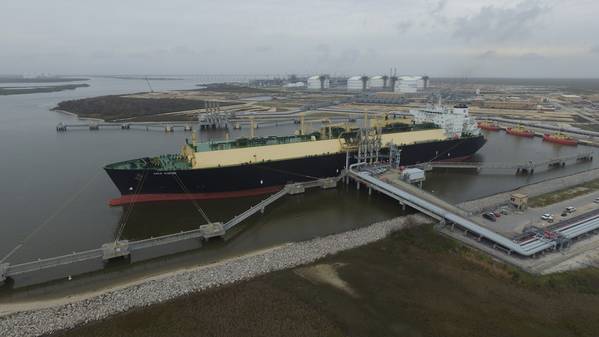
U.S. shipments of liquefied natural gas are expected to fall to their lowest level in six months in April, after a leading U.S. supplier shut units for maintenance at a time when a glut of supply has driven some worldwide prices to near three-year lows.
Based on exports through April 10, the United States is on track to sell roughly 91.5 billion cubic feet per day (bcfd) of natural gas as LNG, which would be the lowest since October. That compares with an estimated record 139.8 bcfd shipped in March, according to data provider Refinitiv.
One billion cubic feet of gas is enough to supply about 5 million U.S. homes for a day.
The dropoff is largely due to a decision by Cheniere Energy Inc, the leading U.S. supplier of LNG, to shut three of the five liquefaction trains, as LNG units are called, at Sabine Pass in Louisiana for planned maintenance over the past three weeks.
Demand for LNG has surged worldwide, rising by 9.8 percent in the most recent year, according to the International Gas Union (IGU).
European and Asian gas prices almost always trade at a vast premium over U.S. gas.
But that changed of late, as gas prices in several European and Asian <LNG-AS> markets fell by more than half this winter, cutting their premium over the U.S. fuel due to record LNG supply and a warm winter that left stockpiles much higher than usual at this time of year.
That caused some Asian buyers to shun U.S. cargoes and redirect them to Europe where shipping costs are lower. It takes about three to four weeks for a tanker to travel from the United States to Asia but only one to two weeks to get to Europe.
As Asian, European and U.S. gas prices converged, some energy traders speculated it might not make economic sense for U.S. exporters to keep sending LNG cargoes to Europe if the arbitrage or price difference between the United States and Europe closes.
Analysts at consultancy Energy Aspects, however, said it does not expect that arb to close until prices in northwestern Europe fall below US$4.15 per million British thermal units (mmBtu).
Gas at the Title Transfer Facility or TTF hub in the Netherlands fell to $4.42/mmBtu last week, its lowest since September 2016. That compared with $2.64 at the U.S. Henry Hub benchmark in Louisiana.
GRAPHIC: European, Asian and U.S. natgas prices converge, see https://tmsnrt.rs/2X0PAST
While Cheniere did not cite low global prices for shutting trains for maintenance, analysts said the timing made sense.
"Producers will certainly tailor their annual maintenance to reflect market realities. We believe we are already seeing this at Sabine Pass," said Ira Joseph, global head of gas and power analytics at S&P Global Platts in New York.
Cheniere owns two of the nation's three operating LNG export terminals - Corpus Christi in Texas and Sabine Pass.
Reporting by Scott DiSavino