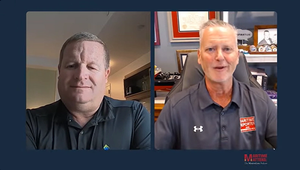
Kris Shepherd has been appointed the General Manager of GE’s marine gas turbine business.
Shepherd, based in Evendale, OH, is responsible for the full lifecycle of all GE marine gas turbine programs, product management, engineering, marketing, supply chain, services, and commercial organizations.
GE's marine gas turbine business serves commercial and naval customers worldwide and offers a suite of six propulsion engines to meet any mission profile with power options from 4.6 megawatts to 52.7 MW: LM500 (4.6 MW), base LM2500 (25.1 MW), LM2500+ (30.2 MW) and LM2500+G4 (35.3 MW), as well as the LM6000PC (46.1 MW) and LM6000PG (52.7 MW) gas turbines.
Shepherd brings with him significant experience as a GE commercial aircraft engine product leader, serving Boeing and other GE engine customers. He managed the CFM LEAP-1B product line for the past seven years and led the LEAP-1B program from start up to successful 737MAX/LEAP-1B entry into service, delivering over 1,200 engines to Boeing and customers.
Shepherd graduated from the University of Cincinnati with a master’s degree in industrial engineering and a bachelor’s degree in mechanical engineering from Ohio University. He is a Cincinnati native currently residing in Wyoming, Ohio.