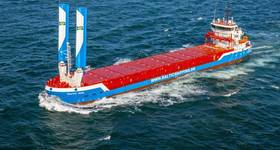
The first unit of a new bulk carrier developed by Mitsubishi Heavy Industries, Ltd. (MHI), a vessel offering superlative energy efficiency and environmental performance, was delivered today to Archer Daniels Midland Company (ADM) of the U.S., one of the world's foremost grain processors, following its completion at Oshima Shipbuilding Co., Ltd. of Nagasaki, an MHI licensing partner. The incorporation of a wide spectrum of innovative technologies - including MHI's proprietary Mitsubishi Air Lubrication System (MALS), which reduces frictional resistance between the vessel hull and seawater using air bubbles produced at the vessel bottom - has enabled a 27% reduction in CO2 emissions, as verified, compared to conventional bulk carriers, exceeding the target figure of 25%.
The newly delivered bulk carrier is the first of three vessels, designed to serve as grain carriers, ordered by ADM in 2011 from Sumitomo Corporation. The vessel was constructed by Oshima Shipbuilding with MHI providing the conceptual design and various green technologies, including MALS. Delivery of the three vessels is scheduled for completion by mid-2015. The carriers are 237 meters (m) in length, 40m in width, and 12.5m in designed draught: deadweight tonnage (DWT) is approximately 95,000 tons.
The new vessel also features a new bow shape designed to reduce wave-making resistance. For propulsion, an innovative system is adopted that effectively converts the main engine power into propulsion power by positioning fins forward of the propellers and placing special grooves in the propeller boss cap. The ship's shallow draught facilitates MALS's pursuit of energy savings and CO2 emission reductions.
In MALS, the air blown from the vessel's bottom produces small air bubbles that cover the vessel's bottom like an "air-carpet," reducing friction between the hull and seawater during navigation. The system was developed by MHI with support from ClassNK (Nippon Kaiji Kyokai) et al., and it has already been adopted in module carriers, ferries and other ships constructed by MHI. In this way MALS has built up a solid track record demonstrating the effectiveness of its technologies in reducing fuel consumption and easing environmental loads. Seafaring tests have already verified that MALS achieves the target level of performance in the newly delivered bulk carrier.
With the increasing adoption of international rules on easing environmental burdens imposed by marine transport, expectations of and demand for environmentally harmonious "Eco-ships" are steadily rising. In response MHI is not only developing and constructing Eco-ships of every kind, the company is also applying its expertise accumulated in its shipbuilding and ocean development businesses to provide engineering support to other shipbuilders. By focusing on promoting expanded adoption of MALS and other energy-saving and environmentally compatible technologies, the company looks to make significant contributions to the development of the marine transport industry.