Each year, criminals try to smuggle countless stolen vehicles through U.S. ports, attempting to load them onto merchant vessels for destinations overseas.
The U.S. Customs and Border Protection (CBP) has been cracking down on these efforts. During fiscal year 2023 (Oct.1, 2022 – Sept. 30, 2023), CBP recovered 1,316 stolen vehicles nationally before they could be exported from the United States—an increase of about 6.5%.
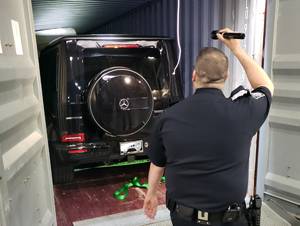
To help stop the thieves, CBP performs rigorous import and export examinations. During vehicle examinations, CBP officers inspect export documentation and compare a vehicle’s identification number (VIN) against stolen vehicle reports.
“The international trade in stolen vehicles is just one of many revenue streams for transnational criminal organizations, so Customs and Border Protection officers will continue to strike back by recovering these vehicles and reuniting them with their lawful owners,” said Matthew Davies, Acting Director of CBP’s Baltimore Field Office. “Auto theft remains a rising concern in the United States. CBP remains committed to working with our federal, state, and local partners to hold these exporters accountable.”
CBP Baltimore, which covers an area from Trenton, N.J., to the Virginia – North Carolina state line, is one of the nation's top field offices for intercepting stolen vehicles. During FY2023, it intercepted 343 stolen vehicles, a 44% increase over the previous year’s recoveries. The recovered vehicles, recovered at Port of Norfolk-Newport News (180), Port of Baltimore (141) and Port of Philadelphia and the Port of Wilmington, Del. (22), were valued at about $17.7 million.
Subcompact to full-sized sport utility vehicles remain the most popular auto theft targets, with Land Rover Range Rover being the top target. The most expensive recovered stolen vehicle was a $250,377 2022 Lamborghini Urus, being shipped from Norfolk to Togo. The oldest vehicle was a 1991 Toyota pickup, valued at $2,150, being shipped from Wilmington to Honduras.
About 90%, or 310, of the stolen vehicles recovered by CBP officers in the Baltimore Field Office were destined to West Africa. Top destinations include Ghana (69 vehicles), Togo (59), Liberia (47), Nigeria (45), and Sierra Leone (45).
During many of the seizures, CBP officers partnered with special agents from Homeland Security Investigations (HSI), who, along with their state and local law enforcement partners on HSI’s Border Enforcement Security Task Force (BEST) carried out investigations into the stolen vehicles. These investigations are bearing convictions.
On June 6, the U.S. Attorney’s Office for the District of Maryland announced the sentencing of two Laurel, Maryland men for illegally shipping stolen vehicles to West Africa.