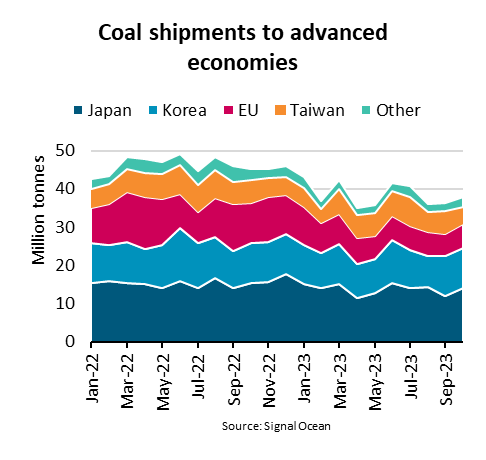
“In the first 10 months of 2023, coal shipments to advanced economies fell by 17% y/y, as demand for electricity declined and the share of electricity produced using renewable energy rose. Also slowed economic activity and high energy prices affected electricity demand,” says Filipe Gouveia, Shipping Analyst at BIMCO.
Between January and August, electricity production in advanced economies fell by 4% y/y, according to data from the International Energy Agency. In 2023, measures against high inflation slowed economic growth in advanced economies. The International Monetary Fund estimates GDP in advanced economies will grow by only 1.5% in 2023 compared to 2.6% in 2022, and some economies in Europe are even expecting negative growth. As a result, industrial production weakened in several of these economies, further affecting electricity demand.
Thermal coal accounted for 68% of coal shipments which fell by 22% y/y, between January and October this year. Thermal coal is used for electricity generation and is being phased out across many advanced economies in favour of renewable energy. Coking coal imports by advanced economies also fell, but only 2%, due to lower steel production in the EU, Japan and South Korea.
“In 2023, advanced economies’ imports of seaborne coal could reach the lowest level since 2002. Imports fell in most of these markets, but the decline was most significant in the EU. After it boosted imports in 2022 in response to an energy crisis, volumes retreated once again and are now below 2021 levels,” says Gouveia.
Advanced economies import 32% of the world’s seaborne coal shipments. Japan, Korea, the EU and Taiwan are the largest importers, accounting for 94% of all coal shipments to advanced economies. Australia is the origin of 40% of these cargoes, favoured for the high energy content in its coal. Other exporters include Indonesia, Russia, US, Canada, Colombia and South Africa.
Despite weaker shipments to advanced economies, global coal shipments are expected to grow 4.5-5.5% in 2023. Stronger demand in parts of Asia, particularly in China, has supported coal shipments this year. Average haul also increased 1.5-2.5%, boosted by sanctions on Russian coal.
“In the coming years, coal shipments to advanced economies are expected to continue declining as electricity generation from renewables increases. While higher demand in emerging Asia may cover some of these losses, we currently expect global coal shipments could start falling from 2024,” says Gouveia.