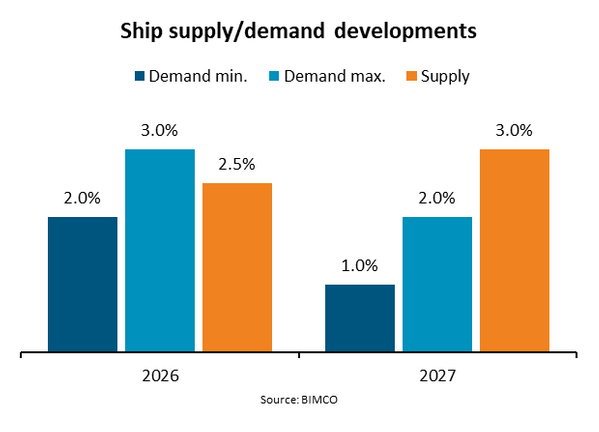
BIMCO estimates that the dry bulk supply/demand balance will remain stable in 2026 and weaken in 2027.
“An improvement in the economic and demand outlook has led us to revise our demand forecast for 2026 up by 0.5 percentage points,” says Filipe Gouveia, Shipping Analysis Manager at BIMCO.
The International Monetary Fund (IMF) has revised global economic growth projections for 2026 up 0.2 percentage points amid stimulus policies and strong investment in technology and AI. Consequently, the global economy is now forecast to grow 3.3% in 2026, the same as in 2025, and by 3.2% in 2027. China’s economic outlook has also improved, due to higher stimulus and to China’s trade agreement with the US, but the IMF still expects a gradual slowdown in the country’s GDP growth.
“Freight rates could remain strong in 2026, as strong market conditions carry over from 2025. However, in 2027, we expect that they could start to slip, reflecting the weaker market conditions. Overall, we expect that the capesize segment might continue to outperform the other segments, supported by low fleet growth and benefiting from growing sailing distances,” says Gouveia.
Ship demand is forecast to grow 2-3% in 2026 and 1-2% in 2027. Average sailing distances are estimated to lengthen 0.5-1.5% each year, due to an increase in iron ore and bauxite shipments from the South Atlantic to Asia. Furthermore, cargo volume growth is being driven by stronger grain and minor bulk shipments. However, a weak outlook for iron ore and coal volumes is limiting gains.
Ship supply is expected to grow 2.5% in 2026 and 3% in 2027. Fleet growth is accelerating, supported by a rise in deliveries, especially in the panamax and supramax segments. Ship recycling is also forecast to increase, while still remaining low compared to historical levels. Lastly, sailing speeds are expected to fall slightly in both years, particularly in segments other than capesize.
Since our last update, the likelihood of dry bulk shipping’s full return to the Red Sea has improved. The last attack on ships by the Houthis occurred on 29 September and in October there was a ceasefire in Gaza, leading to a slight increase in transits. However, geopolitical instability continues in the Middle East and so the timeline for resuming normal operations in the region is still unclear.
“The potential full return of ships to the Red Sea poses a significant downside risk to the demand outlook. We estimate that a full return would be equivalent to a 2% decrease in tonne mile demand, due to a reduction in average sailing distances,” says Gouveia.