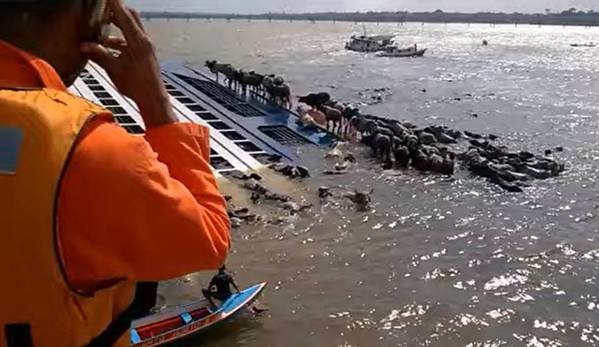
A global network of 36 animal welfare and protection organizations around the world has issued an urgent call to the IMO to introduce binding international regulations for livestock carriers, warning that the ageing fleet poses serious and escalating risks to human life, animal welfare, public health, and the marine environment.
In an open letter sent to the IMO Secretary-General, the organizations outlined systemic safety failures across the global live export shipping fleet, which is now the oldest of any ocean shipping sector, with an average vessel age of 40 years.
The call follows the recent disaster involving the livestock carrier MV Spiridon II.
“These disasters are not accidents. They are the predictable result of a system that allows substandard vessels to carry living animals without any specific international safety or welfare codes,” said veterinarian Dr Maria Boada Saña, project manager sea transport for Animal Welfare Foundation and Tierschutzbund Zürich.
“The reality is that livestock vessels have remained the most detained ship type globally since 2017, despite representing only a small percentage of the world fleet and ourselves and our coalition partners find this totally unacceptable which is why we have formally approached the IMO,” she added.
“No other shipping sector would be allowed to operate with vessels this old, this unsafe and this poorly regulated while carrying living, sentient cargo,” said Saña.
Since 2000, at least seven major livestock carriers have been lost at sea, resulting in the deaths of dozens of seafarers and tens of thousands of animals. Disasters include Gulf Livestock 1 (2020), Haidar (2015), Queen Hind (2019), Al Badri (2022) and Danny F II (2009).
Ongoing research over many years has shown that animals transported on long-distance sea voyages often endure extreme heat stress, overcrowding, prolonged confinement in waste-soaked pens, as well as disease and injury. In addition, increasingly seafarers are faced with unsafe working conditions, exposure to zoonotic diseases and collapsing animal decks.
As a result of these constant animal welfare issues, several countries, including Australia, New Zealand, India, and the United Kingdom, have already legislated bans or phase-outs of live exports by sea.
Yet globally, around 110 livestock carriers continue operating, with vessels regularly discharging untreated animal effluent and carcasses at sea, including in protected Special Areas such as the Mediterranean, Red Sea and Persian Gulf.
"This trade has been described by exporters themselves as very high risk, and outcomes regularly prove this to be correct,” says former live export veterinarian Dr Lynn Simpson. “It is 100% reliant on unacceptable risks that knowingly endangers millions of animals’ safety and lives every year, jeopardizing crew, maritime, and environmental safety with every voyage.
“The more regulated countries have an ‘acceptable mortality rate’ per voyage; the less regulated ones do not even have to report if the entire consignment disappears. What other passenger service knowingly and repeatedly operates under such uncaring policy of life and suffering?
“This is a dying trade, that needs to be regulated properly to avoid a twilight of ever-increasing disasters occurring. The dangers are obvious, and can be greatly mitigated with the immediate adoption of an international code of carriage for livestock such as the Marine Orders 43 that is currently implemented and managed by the Australian Maritime Safety Authority. A code that is already improving safety, voyage by voyage, ship by ship."
In their collaborative letter, the global network of animal welfare advocates calls on the IMO to urgently:
• Develop a binding International Code for the Carriage of Livestock
• Mandate enforceable standards for vessel design and stability, ventilation and life-support systems, waste and carcass management, crew safety and animal welfare
• Require contingency plans to prevent open-ended voyages when animals are refused unloading
• Strengthen port inspection regimes worldwide
• Investigate widespread violations of MARPOL pollution laws.