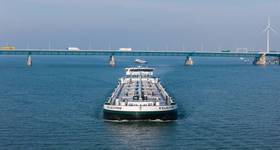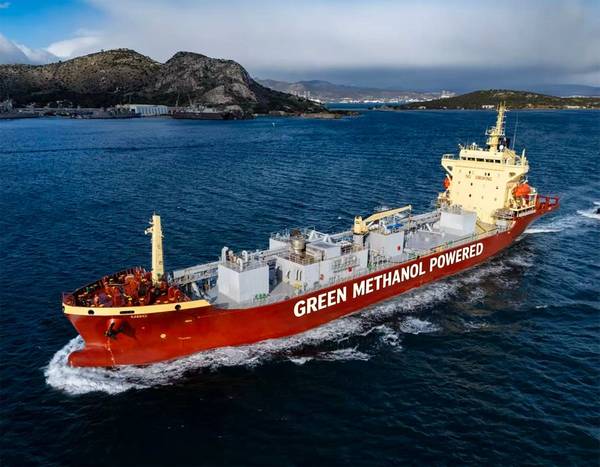
Heidelberg Materials Northern Europe has taken a decisive step toward low-emission coastal logistics with the development of a next-generation methanol-powered cement carrier, an 80% emissions-cutting vessel that could redefine short-sea bulk operations in Scandinavia.
Planned to enter service in early 2028, the newbuild is the product of a multi-stakeholder public-private partnership involving the Hartmann Group, the Green Shipping Programme (GSP) and the Norwegian NOx Fund, all working toward one objective: scaling practical decarbonization in everyday maritime trades.
For Heidelberg Materials, one of Europe’s largest suppliers of cement and aggregates, the vessel marks a shift in strategy. As cement production becomes cleaner through carbon-capture technologies like those at the Brevik plant, transportation emissions account for a greater share of total footprint. The company distributes more than 3.5 million tons of cement by ship annually across Norway, Sweden, Finland, Denmark, Iceland and the Baltics. Improving vessel efficiency isn’t just desirable—it is essential.
“This project reflects our strong commitment to sustainable logistics and long-term climate action,” said Knut Omreng, Director of Logistics, Heidelberg Materials Northern Europe. “The vessel cuts emissions by 80% and increases our transport efficiency. A 10-year contract signals our willingness to support innovation and build lasting partnerships.”
A New Class of Methanol-Powered Bulk Carrier
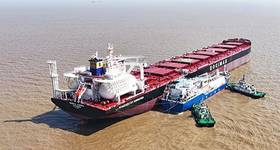
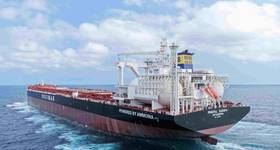
Following a competitive tender, the Hartmann Group—a specialist in bulk and pneumatic cement carriers—was selected to design, own and operate the vessel. The ship is being engineered for high-frequency Norwegian coastal service, supplying low-emission cement from Brevik to key markets including Oslo, Bergen, Kristiansand and Stavanger.
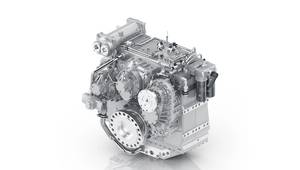
At approximately 9,000 tons of cargo capacity, the new vessel will carry 1,000 tons more than its predecessor, while consuming less total energy thanks to an optimized hull and power arrangement. Its dual-fuel methanol/diesel propulsion plant allows operators to adjust fuel mix based on methanol availability and cost, while maintaining emissions well below today’s diesel-powered bulkers.
For Hartmann, the vessel reflects a broader industry shift.
“We are committed to investing in environmentally friendly technologies that reduce maritime carbon footprint,” said Niels Hartmann, CEO, Hartmann Holdings. “This project shows how cargo owners and shipping companies can jointly drive innovation in low-emission transport.”
BY THE NUMBERS: METHANOL-POWERED CEMENT CARRIER
Cargo capacity | ~9,000 tons of cement
Capacity increase | +1,000 tons vs. current vessel
Fuel system | Dual-fuel methanol/diesel
Primary fuel | Green methanol
CO₂ reduction | Up to 80% vs. diesel vessels
Annual CO₂ savings | Up to 6,000 tons
Delivery | Q1 2028
Operating region | Norwegian domestic coastal routes
Primary ports | Oslo, Bergen, Kristiansand, Stavanger
Contract period | 10-year time charter
Financial support | NOK 60 million from the Norwegian NOx Fund
This vessel would not have been possible without Norway’s maritime innovation ecosystem—particularly the Green Shipping Program and the NOx Fund.
Green Shipping Programme (GSP)
Administered by DNV for the Ministry of Climate and Environment, the GSP brings together shipowners, charterers, technology developers and regulators to accelerate pilot projects across alternative fuels and vessel design.
“For the green transition to succeed, cargo owners must demand low-emission vessels,” said Jørgen Laake, Interim Head of Programme, GSP. “Heidelberg Materials has done exactly that. This methanol-powered newbuild expands the portfolio of contracted low- and zero-emission vessels supported through GSP.”
NOx Fund: Critical Financial Catalyst
Heidelberg Materials secured NOK 60 million to offset the higher cost of a first-of-kind methanol-fueled cement carrier, making the project commercially viable.
“This vessel is a tangible result of public-private collaboration,” said Tommy Johnsen, Managing Director, Norwegian NOx Fund. “It sets a new benchmark for low-emission bulk transport.”
The vessel is a strategic link in Heidelberg Materials’ wider decarbonization roadmap. With the introduction of products such as evoBuild and evoZero—cement produced with significantly reduced emissions due to carbon capture at Brevik—the company must now decarbonize transportation to maintain meaningful overall reductions.
“Transporting low-emission cement on a low-emission vessel aligns with our ambition to reduce carbon footprint from production to delivery,” the company said. This 9,000-ton methanol carrier may prove to be more than an isolated newbuild; it offers a practical, scalable template for decarbonizing short-sea trades. By combining a commercially flexible fuel system, energy-optimized hull, and multi-stakeholder financing model, Heidelberg Materials and Hartmann are demonstrating how industrial cargo owners can accelerate maritime innovation.