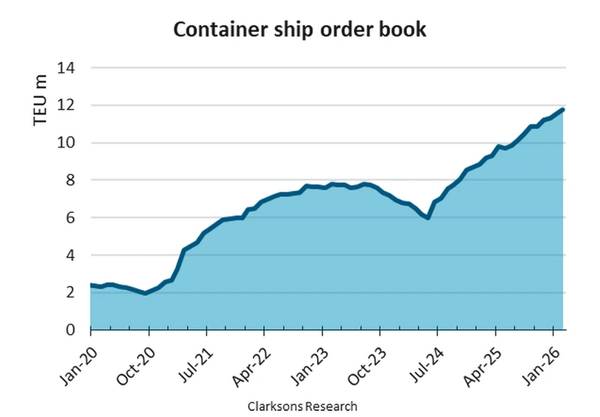
"Despite increasing trade policy uncertainty and falling freight rates, the container ship order book has continued to expand. It now totals more than 1,350 ships with a combined capacity of 11.8m TEU,” says Niels Rasmussen, Chief Shipping Analyst at BIMCO.
In 2025, global average container freight rates fell an estimated 13% year-on-year while US import tariff increases raised concerns about increasing trade protectionism. Despite this, global container volumes grew 4.7% year-on-year, according to Container Trade Statistics, and shipowners ordered a record high 4.8m TEU of new ship capacity.
During the first two months of 2026, shipowners have ordered another 102 ships with a combined capacity of 665k TEU, bringing the total order book to 11.8m at the end of February; an increase of 28% year-on-year.
“The very largest ships dominating the order book point to a development where larger ships will replace smaller ones throughout the global network of services. 436 ships with capacity of 12k TEU or more are on order and make up 65% of the TEU on order,” says Rasmussen.
However, it is the order book for the smaller ships that has grown the fastest during the past year. The order books for the 0-3k TEU, 3-6k TEU and 6-8k TEU size segments have all more than doubled during the past year, whereas the rest of the order book has grown by only 17%.
The combined order book of the three smaller segments only makes up 16% of these segments’ current fleet capacity, however. As 29% of the capacity in the three segments is currently provided by ships 20 years old or older, recycling of older ships could thereby match, or even exceed, the number of new ships being delivered from the order book in the coming years.
The increasing number of very large ships on order is also driving a significant change in the container fleet’s ownership structure.
At the beginning of the 2020s, non-operating owners controlled 43% of the capacity in the fleet. That has since fallen to 36% and will continue to fall as the non-operating owners only account for 24% of the capacity on order.
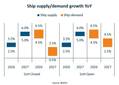
“During 2025-2029, a total of 11.8m TEU is scheduled to be delivered. Even if all ships currently 22 years old or older are recycled before the end of 2030, the fleet would continue to grow on average 6.1% per year as it has done so far this decade. This could potentially create a rather challenging supply/demand environment for liner operators to manage,” says Rasmussen.