America’s maritime infrastructure is measured in draft depth, vessel clearance, sediment management, and days available to dredge. If the United States is serious about competing in a century defined by supply chains, energy exports, and sealift readiness, then ports, harbors, and waterways must move from being in the background to becoming part of the national strategy.
Across the Gulf Coast and beyond, the evidence is clear: when Congress, the Administration, industry, and the U.S. Army Corps of Engineers align, progress follows.
Recently, the Dredging Contractors of America received a warm bipartisan reception in the House of Representatives as members submitted a Sense of Congress draft resolution through the WRDA 2026 portal to expand dredge windows. That proposal is grounded in a simple principle—modern science and adaptive management should guide dredging schedules, not outdated assumptions. Restricting activity in major gateways to narrowly defined windows that limit work to roughly one-third of the year constrains commerce, increases costs, and undermines reliability. Expanding dredge windows responsibly is not deregulation; it is disciplined modernization.
That same theme carried into the Pentagon earlier this year, when several dredging company owners and chief executives joined me for a meeting with Assistant Secretary of the Army for Civil Works Adam Telle. His message was direct: the United States is engaged in a 21st-century competition with China for economic leadership, and infrastructure is central to that competition. He emphasized a focus on building infrastructure—not paperwork—and expressed full support for using real science and adaptive tools to increase the number of workable dredging days where appropriate.
Mr. Telle reminded us that next year marks the 100th anniversary of the Great Mississippi Flood of 1927. That event reshaped federal flood control policy and reinforced a national understanding that water management requires foresight and engineering discipline. The dredging industry stands ready to support commemorative events honoring that history while reinforcing a simple truth: resilience is built, not assumed.
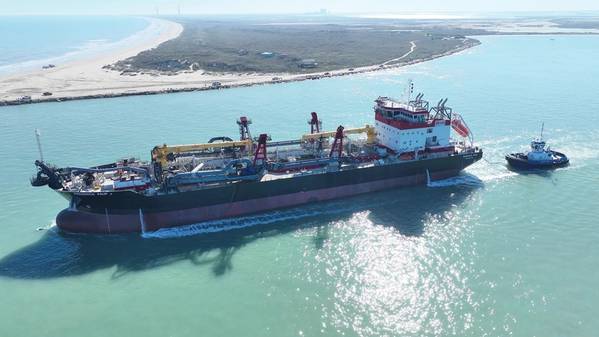
Investment is already reflecting that mindset. On January 27, 2026, Manson Construction’s newest hopper dredge, the FREDERICK PAUP, departed the Seatrium AmFELS shipyard in Brownsville, Texas, bound for Mobile, Alabama. It is the largest self-propelled hopper dredge ever constructed in the United States and represents Manson’s largest single investment since its founding in 1905.
At 420 feet in length with a hopper capacity exceeding 15,150 cubic yards, powered by 25,000 horsepower and equipped with dynamic positioning, advanced dredging systems, Tier 4 diesel-electric engines, and optimized hull design, the vessel reflects next-generation American engineering and shipbuilding. It transitioned directly from delivery into U.S. Army Corps of Engineers Mobile District work, performing essential maintenance dredging that keeps deep-draft navigation reliable.
That is what maritime strategy looks like in practice: American shipyards building Jones Act vessels, crewed by American mariners, maintaining federally authorized channels that move agricultural exports, LNG cargoes, containerized freight, and military sealift assets.
At the same time, the Gulf Coast is advancing the national conversation around beneficial use of dredged material. Alabama’s recent legislative activity addressing sediment placement practices in Mobile Bay highlights the increasing scrutiny and engagement surrounding environmental stewardship. Federal law already directs that not less than 70 percent of suitable dredged material be used beneficially where feasible, encouraging collaboration between the Corps and local stakeholders to align navigation and restoration objectives. Navigation and environmental performance are not opposing goals; they are increasingly integrated disciplines.
Dredging policy is not a narrow industry issue. It is foundational to port competitiveness, shipyard workload stability, energy security, coastal resilience, and national defense readiness.
The Gulf Coast provides a blueprint. Congress is engaging through WRDA. The Administration is emphasizing infrastructure delivery. Industry is investing in modern, U.S.-built vessels. States are refining sediment management policies. The Corps remains the operational backbone.
What is required now is resolve. Resolve to modernize dredge windows using data. Resolve to continue building Jones Act vessels in American yards. Resolve to align environmental policy with navigation reliability. And resolve to recognize that ports and waterways are not peripheral but rather, they are strategic assets in a competitive global economy.
America has built its strength on maritime commerce for more than two centuries. The question is not whether we can build again. The question is whether we will choose to do so with urgency and unity.
The path forward is clear. Dredging is foundational. Infrastructure is strategy. The will to build must remain national.