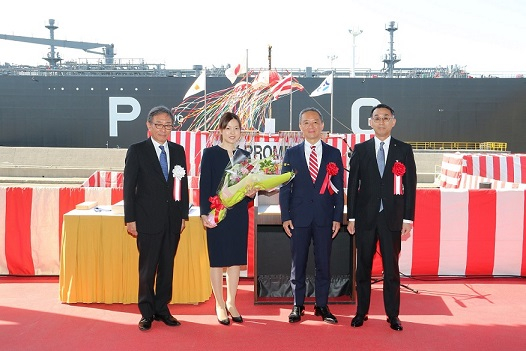
A naming ceremony was held in Kumamoto Prefecture at the Ariake Shipyard of Japan Marine United Corporation for a new VLGC (very large gas carrier) that NYK will charter under a long-term contract to Astomos Energy Corporation, pre-eminent liquefied petroleum gas (LPG) company.
The ship was named “Lily Promenade” by Kazuhisa Otsuka, senior operating officer of Astomos Energy Corporation, and the ceremonial rope holding the vessel in place was cut by Mariko Kurokawa of Astomos. Akira Kono, NYK managing corporate officer, attended together with others from the company.
The ship is the first new NYK-owned VLGC to include an SOx scrubber that is compliant with the International Maritime Organization’s (IMO) more stringent SOx emission regulation, which is scheduled to become effective in January 2020. The ship will be about 10% more energy efficient (reducing CO2 emissions per unit of transport), exceeding the IMO EEDI phase 1 requirements that will become effective in 2020. In addition, an energy saving devices and the low-friction paint make the ship a more fuel efficient tanker.
Vessel Particulars
Length overall: 230 meters
Breadth: 36.6 meters
Molded depth: 22.2 meters
Cargo tank capacity: about 83,000 cu. m.
Gross tonnage: about 51,000 tons
Shipbuilder: Japan Marine United Corporation
Flag: Panama
Delivery: Scheduled for October 30, 2019