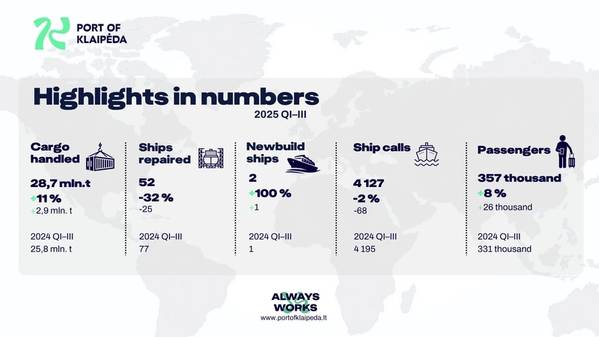
Over the first nine months of this year, cargo throughput at the Port of Klaipėda increased by 11% compared to the same period last year, reaching 28.7 million tons. The largest share of cargo flow consists of container cargo and ro-ro, alongside a significant increase in LNG and construction materials.
Container cargo showed the strongest growth this year, increasing by 31% to almost 9.6 million tons.
Handling of liquefied natural gas (LNG) and construction materials grew by 23% each over the first nine months, reaching about 1.7 million tons. The FSRU “Independence” continues to play an increasingly important role at Klaipėda Port, driven by the geopolitical situation and Lithuania’s decision to end gas imports from Russia. The rise in construction materials is linked to active road and railway projects in Lithuania. In the ro-ro (roll-on/roll-off) segment, cargo volumes increased by 6%, reaching almost 5 million tons, while oil product handling grew by 2% to nearly 3 million tons. These segments are influenced by global market trends, geopolitical factors, and green transition policies.
The number of passengers traveling through Klaipėda Port increased by 8% this year compared to last year – 26,395 more people arrived or departed by sea. The number of cruise passengers was also up by 12%.
Over the first three quarters, 52 ships were repaired and 2 new ones were built at Klaipėda Port.
Compared to the same period last year, scrap metal handling fell by 18%, and wood handling decreased by 16%. All wood handled at Klaipėda Port was exported, with 83% shipped to Scandinavian countries. Fertilizer handling also dropped by 13%. Due to sanctions on Russia and Belarus, fertilizer flows from these countries have stopped. Currently, the port mainly handles fertilizers produced by Lithuanian companies AB “Achema” and AB “Lifosa.” Grain handling declined by 10%. The volume of grain exported through the port depends on harvest levels in Lithuania and domestic demand. Each year, Lithuania produces around 6–7 million tons of grain, of which about 70–80% is exported — most of it through Klaipėda Port.
Despite declines in a few cargo groups, Klaipėda Port has maintained its leading position among neighboring ports. In terms of market share, Klaipėda holds 41%, followed by Riga (17.5%), Tallinn (14.6%), Ventspils (just over 9%), and Liepaja (a little over 7%).