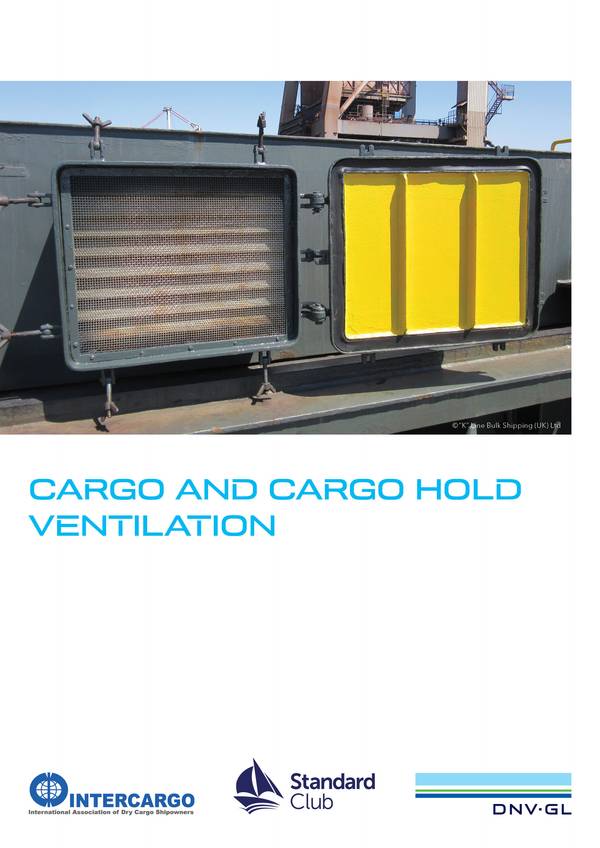
Proper ventilation is essential to preventing damage to the cargo and to ensure the safety of the crew and vessel in bulk carriers. To provide ship’s masters and crew with an understanding of different ventilation requirements for bulk cargoes, INTERCARGO, The Standard Club and DNV GL, the world’s leading classification society, have launched a new ventilation guide.
The guide covers the main aspects on how and when to ventilate to control of humidity and to remove flammable and toxic gases released from cargoes. In addition, fumigation issues and the entry of ship’s personnel into confined spaces are addressed. The guide also sets out the regulatory requirements related to ventilation. Finally, several case studies illustrate practical examples on “what can go wrong” when correct ventilation and stowage procedures are not followed.
“Cargo ventilation is an often overlooked, but essential part of avoiding financial risk and danger to the crew and vessel,” said Morten Løvstad, Business Director - Bulk Carriers, at DNV GL – Maritime. “With this guide we have worked together to examine some of the most common ventilation systems and provide some clear advice on how to deal with ventilation problems and hope this will help to build greater awareness of these issues within the segment.”
“The guide will provide ships’ crew with a practical understanding of when to ventilate and the reasons to do so,” adds Ed Wroe, Technical Manager at INTERCARGO. “Additionally, the guide clearly shows the statutory requirements of cargo and cargo hold ventilation. Working together, INTERCARGO, DNV GL and The Standard Club were able to provide their own areas of expertise to this publication which I hope will be found to be useful throughout the bulk carrier segment.”
In today’s market, ships carry a wide variety of dry cargoes, all with different ventilation requirements depending on the cargo characteristic, voyage, and the weather conditions.
“Ventilating the cargo is not merely allowing the outside air into the cargo hold, but it involves a precise process where a number of factors need to be considered,” said Yves Vandenborn, Director of Loss Prevention, at Standard Club. “Failing to adhere to the requirement may cause cargo damage and result in large losses.”
“Standard Club continues to see high numbers of wet cargo damage claims, caused either by fresh water or seawater, but the most serious damage is due to condensation. Inadequate ventilation and poor stowage may result in caked and mouldy dry cargoes, or rusty steel cargoes. The guide aims to provide a clear and concise understanding of the ventilation requirements for various cargoes and will assist in preventing cargo damage caused by poor ventilation practices on board dry cargo ships,” Vandenborn said.