Physical sampling determined that no oil remains after 70 years.
After 11 days of survey and sampling, using both the latest in technology and physical sampling it was determined that no oil remains on the SS Montebello. The on-scene assessment of the sunken World War II tanker S.S. Montebello is nearly complete off the coast of Cambria, CA. The unified command, led by the Coast Guard and California Department of Fish and Game's Office of Spill Prevention and Response, has determined that there is no substantial oil threat from the Montebello to the surrounding waters and shorelines.
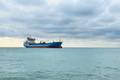
The S.S. Montebello sank after a Japanese submarine torpedoed the large oil tanker on December 23, 1941. The vessel broke apart landing upright with her bow separated from the majority of the wreckage. At the time of sinking no release of the 3.2 million gallon cargo was observed. Over the past few days working under the direction of the unified command Global Diving & Salvage, Inc. has assessed cargo and fuel tanks, as well as collected ocean floor sediment samples. "Our number one objective for this mission was to determine what threat, if any, the Montebello poses to the waters and shorelines of California," said Coast Guard Capt. Roger Laferriere. "After careful evaluation of the data, we have concluded with a high level of confidence that there is no oil threat from the S.S. Montebello."
Global’s Cougar XT ROV was used as the platform which supported the inspection including visual and sonar imaginary which was translated into 3D modeling, thickness gauging, backscatter tooling operations, physical sampling of the tank contents, and sediment sampling from the general area. Global teamed with T & T Bisso to provide engineering support and 3D modeling of the vessel and subcontracted Tracerco to utilize their neutron back scatter tool, a non invasive sensing device which was used to determine the presence of oil and oil/water interface. Physical samples of the cargo tanks were taken to verify its contents utilizing a proprietary sampling / plug device.
“Knowing that this wreck does not pose a significant pollution threat is great news”, says Devon Grennan, President of Global Diving & Salvage, Inc. “The combination of the latest technology, sound planning and project management, excellent collaboration between Federal, State and private enterprise shows the possibilities in investigating these deep water wrecks and the ability to determine the pollution potential.
"This is a new era of prevention," said DFG OSPR Capt. Chris Graff. "This has been a cooperative partnership using cutting-edge technology and surgical precision. The procedures and techniques used could help conduct threat assessments on other sunken vessels."