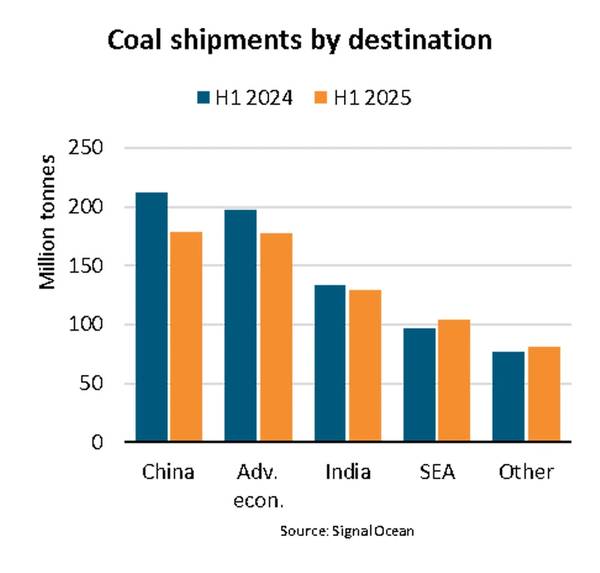
“During the first half of 2025, global coal shipments fell 6% y/y amid weak import demand in large markets. Cargo loadings headed to China and advanced economies slowed considerably, partly due to stronger electricity generation from renewables and to weaker steel production,” says Filipe Gouveia, Shipping Analysis Manager at BIMCO.
In recent years, China has joined several of the world’s advanced economies in rapidly phasing out fossil fuels from its electricity generation, thus reducing import dependence. According to the International Energy Agency, China is currently the largest energy investor in the world, spending almost as much as the EU and the US combined. 71% of its spend is estimated to be on clean energy.
Factors other than domestic demand are also shaping developments in the global coal trade. China and India have been gradually boosting their domestic coal production, reducing import demand. Overland imports into China from Russia and Mongolia have been increasing, directly competing with seaborne imports.
Despite the negative developments for coal shipments, a 19% drop in prices provided some support for imports in price-sensitive economies in South and Southeast Asia. These are markets where energy demand is growing rapidly but investment in renewables has been slower.
“Amid weaker coal volumes, competition between segments in the dry bulk market increased, putting pressure on freight rates. The panamax segment managed to boost its coal shipments by 4% y/y and grew its share of the world’s coal shipments from 49% to 54%. These gains came primarily at the cost of the capesize segment, which transported 23% less coal than in the previous year,” says Gouveia.
Looking ahead, the outlook for coal shipments appears restrained in the short run. Coal inventories are high in both India and China, which is discouraging purchasing, even amid low prices. In addition, in India’s case, the monsoon season started early and has led to rapid refilling of water reservoirs. This is expected to trim its coal demand, as more electricity is generated by hydro power. On the other hand, a heatwave is currently affecting China, which could cause electricity demand to rise due to increased use of air conditioning.
“In the medium term, spikes in demand could emerge during periods of extreme weather or of weak electricity generation from renewables. Furthermore, coal shipments to emerging economies in South and Southeast Asia could continue to rise. However, this is unlikely to stop the expected gradual global decline in coal shipments, which is driven by the energy transition and a weak outlook for global steel demand,” says Gouveia.