Russia remained China's top oil supplier in March, data showed on Saturday, as refiners snapped up stranded Sokol shipments.
China's imports from Russia, including supplies via pipelines and sea-borne shipments, jumped 12.5% on the year to 10.81 million metric tons, or 2.55 million barrels per day (bpd) last month, according to data from the General Administration of Customs.
That was quite close to the previous monthly record of 2.56 million bpd in June 2023.
Seven Russian tankers under sanctions offloaded Sokol cargoes in Chinese ports in March, as Russia worked to clear a glut of stranded supply in the wake of tightened U.S. sanctions.
More than 10 million barrels of the oil supplied by Sakhalin-1, a unit of Rosneft, had been floating in storage over the past three months amid payment difficulties and sanctions on shipping firms and vessels carrying the crude.
Stockpiling of Russian crude for storage in strategic reserves by state-owned CNOOC also boosted imports from Russia.
Data from consultancy Kpler forecast sea-borne shipments from Russia hitting a record high of 1.82 million bpd, including 440,000 bpd of Sokol and 967,000 bpd of ESPO.
Russia was China's top supplier throughout 2023, shipping 2.14 million bpd despite Western sanctions and a price cap following the Kremlin's 2022 invasion of Ukraine.
In coordination with other OPEC+ members, Russia opted to roll forward a voluntary reduction in crude oil output of 300,000 bpd into the first quarter of the year to support energy prices.
Imports from Saudi Arabia, previously China's largest supplier, totalled 6.3 million tons in March, or 1.48 million bpd, down 29.3% on the same period last year.
Riyadh has said it would extend its voluntary cut of 1 million bpd through the end of June, leaving its output at around 9 million bpd.
The world's top exporter kept the March official selling price of its flagship Arab Light to Asia at $1.50 over the Oman/Dubai average as the Kingdom sought to secure market share.
January-March imports from Malaysia, a trans-shipment point for sanctioned cargoes from Iran and Venezuela, soared 39.2% on the year to 13.7 million tons, or 3.23 million bpd.
The data showed 375,296 tons of imports from Venezuela, following a rare shipment of 352,455 tons of Venezuelan crude in February amid a temporary relaxation of U.S. sanctions on Caracas. Sanctions were re-imposed from Thursday after the U.S. said President Nicolas Maduro had failed to meet his election commitments.
Customs recorded no imports from Iran.
Below lists imports from main suppliers with volumes in million metric tons and year-on-year percentage change calculations by Reuters:
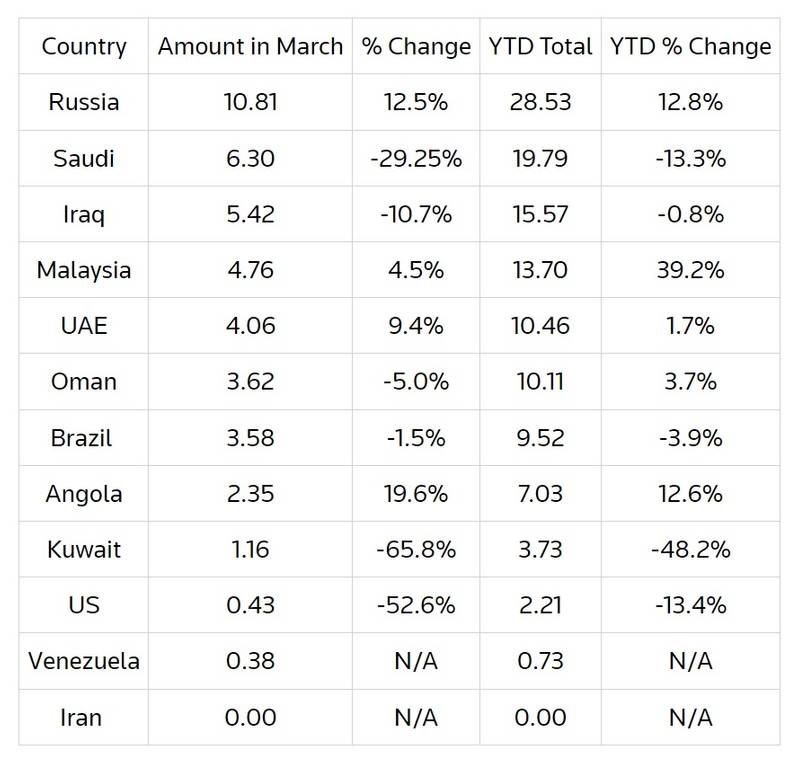
(ton = 7.3 barrels for crude oil conversion)
(Reuters - Reporting by Andrew Hayley and Amy Lv; editing by David Evans and Shri Navaratnam)