Two separate breakaways of container ships berthed at the Port of Brisbane, Australia, after heavy rains highlight the importance of robust emergency and risk management arrangements, according to an Australian Transport Safety Bureau investigation.
The May 2022 incidents occurred after an unprecedented stretch of rainfall resulted in significant freshwater inflows into the Brisbane River following several controlled water releases from dams located upriver.
This resulted in strong currents through the Port of Brisbane, at the mouth of the river, which added strain to the mooring lines holding ships berthed there.
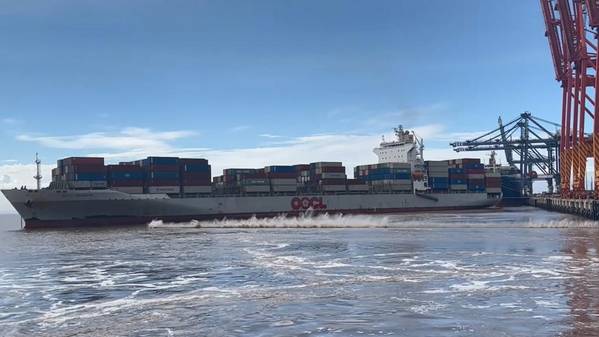
On May 16, 2022, the container ship OOCL Brisbane broke away from berth 10 at Fisherman Islands. Four days later another container ship, CMA CGM Bellini, broke away from berth 6.
“Fortunately, the ships were brought under control in both cases, and there were no injuries or substantial damage in either incident,” ATSB Chief Commissioner Angus Mitchell said. “But breakaways can have serious outcomes.”
The ATSB investigation found that both breakaways occurred due to the strong currents following the high rainfall combined with the interaction forces created when a second container ships passed alongside and then berthed ahead of, each vessel.
The high ebb current speeds and the interaction forces introduced by other vessels resulted in the mooring limits for both ships being exceeded.
In the case of the OOCL Brisbane, all the ship’s mooring lines parted or paid out, and it moved into the Brisbane River before being assisted by tugs. CMA CGM Bellini’s forward mooring lines parted, and its bow drifted off the wharf before it too was assisted by tugs to be secured alongside.
In the course of its investigation, the ATSB identified that Maritime Safety Queensland (MSQ), the regulator, and the Poseidon Sea Pilots (PSP), Brisbane’s pilotage provider, did not have a process to jointly and effectively identify the hazards to shipping and pilotage that were outside normal environmental conditions, and to properly assess the associated risks.
PSP and MSQ have since collaborated with a range of stakeholders to improve extreme weather event planning and response and to establish a formal channel to identify and risk assess hazards to shipping outside of normal environmental conditions.
This has included the establishment of the Port of Brisbane Maritime Emergency Working Group, with guidelines developed for the group’s role in responding to port emergencies.
Additionally, three additional current meters have been installed in the river, adding to the one installed prior to the incident, and additional meters are planned. Data from these meters will be provided by MSQ to key stakeholders, including PSP.
Finally, PSP has provided input for changes to MSQ’s standard port procedures, including the joint development of procedures for movements to and from various berths under flood conditions, using MSQ’s bridge/ship simulator.