Wärtsilä Simulators for New Portuguese Facility

September 16, 2019

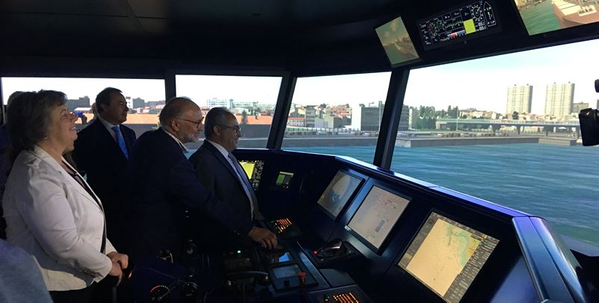
Ana Paula Vitorino, Portugal’s Minister of Sea & Cmdt. Rui Cunha, APDL Port Operations and Security Director, testing the Full Mission Bridge simulator  (Photo: Wärtsilä)
Ana Paula Vitorino, Portugal’s Minister of Sea & Cmdt. Rui Cunha, APDL Port Operations and Security Director, testing the Full Mission Bridge simulator (Photo: Wärtsilä)

Wärtsilä has supplied simulators aimed to provide realistic hands-on training at a new facility in Portugal. 

The training center is developed and run by the Port Authority for the ports of Douro, Leixōes and Vano do Castelo (APDL), and was inaugurated in the end of July at a ceremony headed by Portugal’s Minister of the Sea, Ana Paula Vitorino. The order was placed in October 2018.

The center is the country’s largest and most advanced maritime training facility. It features a Wärtsilä Full Mission Bridge (FMB) simulator with 360 degree projection, two tug simulators with 360 degree LCD, and one VTS simulator to allow full training, complex exercises, and certification for pilots, tug masters, merchant navy offices, and seafaring vessel crews. The simulation technology has been developed by Transas, a Wärtsilä company.

The Wärtsilä scope includes the development of several 3D zones and a tug boat model. Wärtsilä has earlier provided APDL with a VTS system.


Logistics News

Soybeans Futures Rise on US Yield Doubts While Wheat Steadies

Soybeans Futures Rise on US Yield Doubts While Wheat Steadies

Russian Ice-class LNG Carrier heads out via Northern Sea Route

Russian Ice-class LNG Carrier heads out via Northern Sea Route

NIMO, Belfast Harbour Join Port Innovators Network

NIMO, Belfast Harbour Join Port Innovators Network

MacGregor Inks Hatch Cover Deal

MacGregor Inks Hatch Cover Deal

Subscribe for Maritime Logistics Professional E‑News

Boeing's Wisk Sale is unlikely to spark another divestment Round
Data shows that Turkey has cut its Russian oil imports due to Black Sea export disruptions, which have slowed down supplies.
Mexico races to remove record seaweed growth from Caribbean beaches