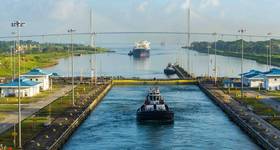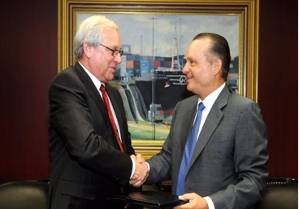
On April 21, 2010 Panama Canal Authority (ACP) Administrator/CEO Alberto Alemán Zubieta and Alabama State Port Authority (ASPA) Director/CEO James K. Lyons signed a Memorandum of Understanding (MOU) to jointly help foster commercial activity between the two entities.
The MOU will increase cooperation, such as joint marketing and coordination on modernization and expansion projects, and help boost trade along the “All-Water Route,” the route from Asia to the U.S. East and Gulf Coasts via the Panama Canal. This arrangement is renewable on a two-year basis.
“This alliance is an example of the ACP’s strategy to forge partnerships with U.S. ports to promote the ‘All-Water Route,’ through the Panama Canal. These alliances will help improve services for our customers, generate commercial activity and foster economic development,” said Mr. Alemán Zubieta.
“As the global economy recovers, we must continually pursue smart business partnerships. The exchange of ideas and information-sharing demonstrate our desire to execute solutions for the long-term growth needs of the shipping community and international trade.”
The MOU between the ACP and the ASPA may also include market studies exchange and technological interchange of advanced capabilities and programs.