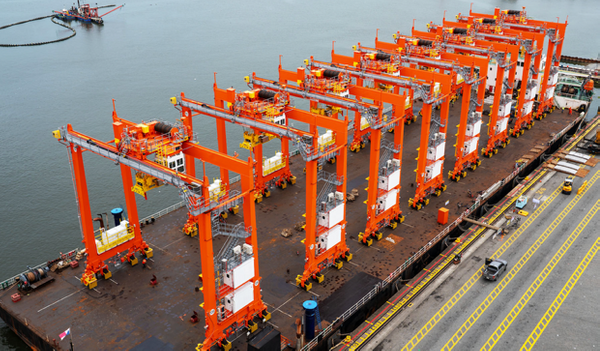
International Container Terminal Services, Inc. (ICTSI) has added eight hybrid rubber-tired gantries (RTGs) to its flagship Manila International Container Terminal (MICT), expanding capacity, improving operational efficiency, and advancing its sustainability goals.
Built by Japan’s Mitsui Engineering and Shipbuilding, the RTGs feature an 80kW lithium-ion power pack paired with a 100kW engine-generator set. The smaller genset, compared to the 220kW units used in conventional Mitsui hybrid RTGs, reduces fuel consumption significantly while cutting emissions. A regenerative braking system captures and reuses energy to recharge the batteries, delivering substantial energy savings and improving overall efficiency.
With the new units, MICT now operates 18 quay cranes and 60 RTGs, the country’s largest container-handling fleet.
The investment is part of ICTSI’s broader expansion program, including the development of Berth 8 and other infrastructure upgrades to increase terminal capacity and streamline operations.
The acquisition also supports ICTSI’s long-term sustainability targets, which include reducing Scope 1 and 2 emissions per container move by 26% by 2030 and achieving net-zero emissions by 2050.