Microsatellites Launched for Maritime Monitoring, Comms and Science
Posted by Eric Haun
July 14, 2017
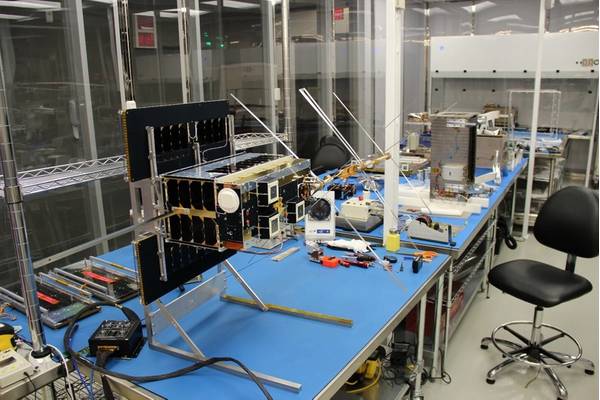
NORsat-2 in the SFL clean room with VDE Yagi antenna deployed. (Photo: Space Flight Laboratory)
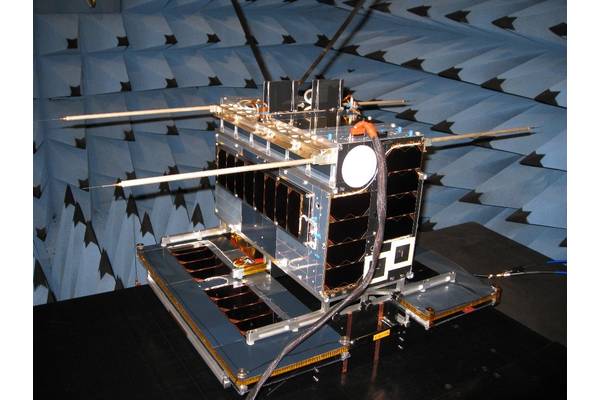
NORsat-1 in EMC test at SFL. Two AIS antennas may be seen at the top, and four Langmuir probes off to the sides. The solar wings of the satellite are at the bottom. (Photo: Space Flight Laboratory)
The Space Flight Laboratory (SFL) announced the successful launch of two Norwegian microsatellites developed and built by SFL for the Norwegian Space Centre with support from the Norwegian Coastal Authority, Space Norway and the European Space Agency. The Soyuz-2.1a rocket carrying the satellites into orbit launched from Baikonur at 06:36:49 UTC Friday, July 14, 2017.
Shortly after launch both satellites were contacted from ground stations in Svalbard and Vardo, Norway. Both satellites are healthy based on initial telemetry, and commissioning is underway.
The first satellite, dubbed NORsat-1 carries a state-of-the-art Automatic Identification System (AIS) receiver to acquire messages from maritime vessels, a set of Langmuir probes to study space plasma characteristics, and a Compact Lightweight Absolute Radiometer (CLARA) to measure total solar irradiation and variations over time. The payloads were provided by Kongsberg Seatex, the University of Oslo and the Physikalisch-Meterologisches Observatorium Davos World Radiation Center.
The satellite is approximately 15 kilograms with main body dimensions of 20x30x40cm. NORsat-1 utilizes SFL’s Next-generation Earth Monitoring and Observation (NEMO) platform, and will serve the Norwegian Coastal Authority in monitoring maritime traffic while also performing ground breaking science.
The second satellite, NORsat-2 also carries an AIS receiver, but in addition has a VHF Data Exchange (VDE) payload that will enable higher bandwidth two-way communication with ships. Both payloads were provided by Kongsberg Seatex. NORsat-2 will be the first satellite to provide VDE services to Norway. Adding VDE enables increased messaging capacity, better reliability of message delivery, and increased range of ship-to-shore and ship-to-ship communication beyond direct line of sight.
SFL’s NEMO platform was used for NORsat-2, and the satellite was integrated in Toronto along with NORsat-1. The relatively large deployable Yagi antenna for the VDE payload was developed by SFL in collaboration with the University of Toronto’s Electromagnetics Group.