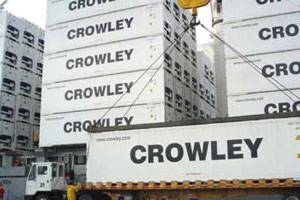
As produce farmers across the Americas gear up for the peak winter produce season, Crowley has added 400 new refrigerated containers to its fleet to accommodate their needs. The 40-ft containers were delivered last week at Puerto Limon in Costa Rica and will be distributed throughout the Central American countries Crowley serves within the next couple of weeks. The state-of-the-art units were purchased to accommodate future growth and to replace older units. The new Carrier PrimeLINE containers offer scroll compressor technology (inspired by the chamberednautilus shellfish). Plus they use environmentally friendly refrigerants and 16 to 20 percent less energy than earlier models.
Since 2003, Crowley has invested almost a quarter of a billion dollars in cargo equipment for its liner services fleet. Today the company owns and leases more than 44,000 pieces of specialized equipment, including more than 20,394 chassis, 18,280 dry containers and more than 3,000 refrigerated containers - all of which come in a variety of sizes and are strategically located throughout the U.S., Central America and the Caribbean.
(www.crowley.com)