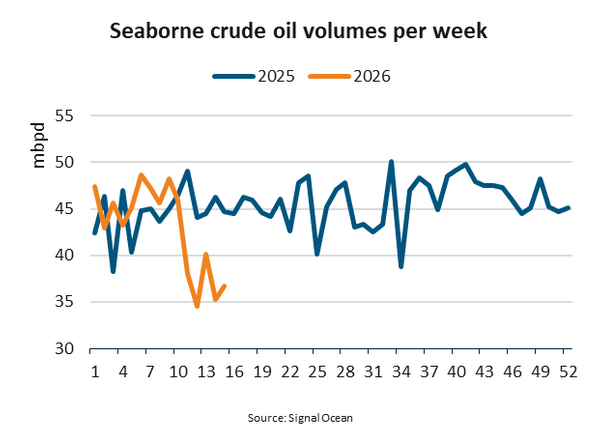
"Since the beginning of the Iran war, global seaborne crude oil shipments have fallen 16% compared to the first nine weeks of 2026, according to Signal Ocean data. This represents a reduction of 7.6 million barrels per day (mbdp) to 38.4 mbpd. Coincidentally, shipments during the past six weeks have likewise been 16% lower than during the same period last year,” says Niels Rasmussen, Chief Shipping Analyst at BIMCO.
Before the Iran war, the U.S. Energy Information Administration had estimated global 2026 oil production to be 79.9 mbpd. The 7.6 mbpd reduction in seaborne shipments thereby means that 9.5% of the previously expected crude oil production is currently not reaching markets.
The reduction in shipments has naturally been driven by the effective closure of the Strait of Hormuz. Since the beginning of the war, tanker transits have reduced to a trickle while other countries have not significantly ramped up exports.
“In total, seaborne crude oil shipments from the Persian Gulf have fallen 12.7 mbpd during the past six weeks compared to the first nine weeks of 2026. The United Arab Emirates has managed to increase loadings from ports east of the Strait of Hormuz by 0.7 mbpd while Saudi Arabia has increased shipments from Yanbu in the Red Sea by 3.0 mbpd,” says Rasmussen.
Adjusting for increased shipments from ports outside the Persian Gulf, crude oil shipments from the region have fallen 9.0 mbpd compared to earlier in the year. In total, other countries have only managed to increase shipments by 1.4 mbpd during the past six weeks compared to the first nine weeks of the year.
Venezuela has increased shipments by 0.4 mbpd while Russian Black Sea shipments are up 0.8 mbpd. Combined, this accounts for 85% of increased shipments from countries outside of the Persian Gulf. India has been the main destination of the increased shipments from both areas.
Since the two-week ceasefire was agreed between the US and Iran, transits through the Strait of Hormuz have failed to pick up significantly. The US decision to block all traffic to and from Iranian ports, except humanitarian shipments, could lead to a further reduction in transits.
“Even if the Strait of Hormuz is fully reopened, it may take a long time for crude oil and other energy shipments to return to previous volumes. According to reporting by the Financial Times, Saudi Arabia’s production capacity has suffered considerable damage while Qatar has lost almost one fifth of its LNG output. At the same time, refinery capacity of about 2.4 mbpd is currently estimated to be offline,” says Rasmussen.