"The Strait of Hormuz has been effectively closed for three months, trapping hundreds of ships and thousands of seafarers in the Persian Gulf while significantly reducing global seaborne tanker volumes,” says Niels Rasmusssen, Chief Shipping Analyst at BIMCO.
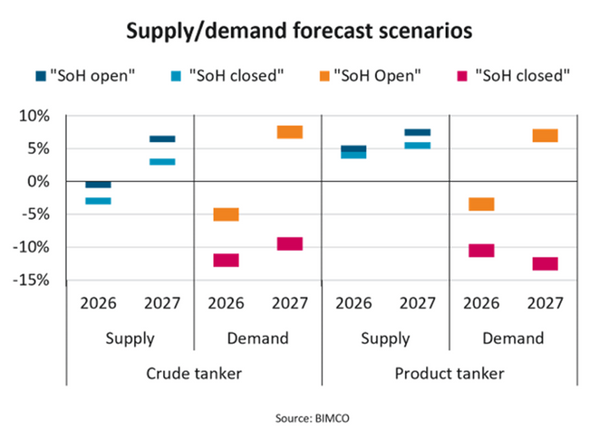
As it is unknown when ships can safely return to the strait, we present two outlook scenarios. One, “SoH open”, assumes that the strait is fully reopened before the end of the second quarter while the other, “SoH closed” assumes that the strait remains effectively closed throughout 2026 and 2027
Since the beginning of the Iran war, dirty and clean tanker cargo volumes have fallen 13% year-on-year. Despite cargo volumes grew before the war, year-to-date cargo volumes have therefore fallen 5% year-on-year, equating to declines of 340 million barrels in the dirty tanker market and 147 million barrels in the clean tanker market.
To counter the missing oil supply, oil stocks have been released at record pace. JP Morgan estimates that 800 million barrels can still be released without touching what is needed to keep minimum pipeline and storage tank levels.
“If the Strait of Hormuz remains effectively closed, oil stocks could reach critical levels by the end of September and may no longer be able to provide a secondary source of oil supply,” says Rasmussen.
On the other hand, rebuilding of global oil stocks could offer additional tanker demand growth once ships can again safely transit the Strait of Hormuz. The International Energy Agency has estimated that as much as 1 million barrels per day for three years may be needed to rebuild stocks.
Saudi Arabia’s and the United Arab Emirates’ ability to divert oil exports to ports in the Red Sea and Gulf of Oman has been invaluable in avoiding a further drop in global oil supply and dirty tanker demand. That has allowed Saudi Arabia to maintain nearly 60% of its pre-war exports despite 90% of exports are normally exported from ports in the Persian Gulf. The United Arab Emirates have similarly been able to maintain more than 70% of its pre-war export volumes.
Following an initial spike in freight rates at the beginning of the war, spot freight rates in most key trade lanes are back at levels similar to those recorded before the war. Freight rates for Persian Gulf exports remain elevated but are mostly theoretical due to the few ships transiting the Strait of Hormuz.
“If the Strait of Hormuz reopens before the end of the second quarter, we expect that cargo volumes will grow gradually during the third quarter, normalize in the fourth and, supported by stock rebuilding, return to growth in 2027. Due to high fleet growth, the product tanker supply/demand balance could, however, still weaken in 2027. If the strait remains closed, we expect cargo volumes to decline as oil stocks are depleted,” says Rasmussen.