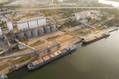
French shipping line CMA CGM SA will no longer run the mega containership Benjamin Franklin between Asia and the U.S. West Coast, on account of weak market conditions, reports FT.
According to sources, Benjamin Franklin’s voyages have been suspended on the route between Asia and U.S. West Coast ports including Los Angeles, Long Beach, Oakland and Seattle, after just five months amid an industry slump that has seen shipping lines’ earnings plummet.
The largest containership to call at a U.S. port when it stopped in Los Angeles in December, Benjamin Franklin, which is 398 meters long and can carry 18,000 20-foot equivalent units (TEUs) of containers, required 56 hours, nine cranes and 11,200 container moves to unload the vessel.
The decision, which CMA CGM disclosed in April, also came as the company arranged a new capacity-sharing alliance with China’s Cosco Group and other rivals. Some analysts speculated that CMA CGM’s partners weren’t interested in adding a fleet of giant ships to the already well-serviced trans-Pacific route.
There was widespread skepticism about the wisdom of deploying such large vessels to the U.S. West Coast because the region’s antiquated ports have been struggling to cope with far smaller vessels.
Other shipping lines use their largest vessels — some of which carry up to 20,000 TEUs — exclusively on Asia to Europe services.