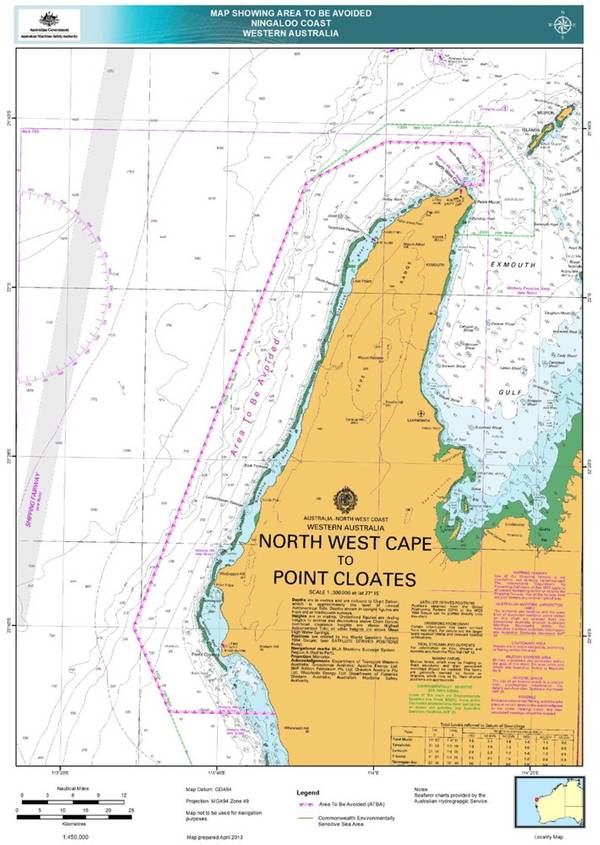
To protect the World Heritage-listed Ningaloo Coast in Western Australia’s north-west region, the Australian Maritime Safety Authority (AMSA) to establish an area ships should avoid.
A new AMSA Marine Notice will recommend ships keep at least two nautical miles from the edge of Ningaloo Reef at its narrowest part, and between eight and 12 nautical miles from the reef along the remainder of the Ningaloo Coast section to reduce the risk of shipping accidents and help protect the World Heritage listed region from ship-sourced pollution.
The Royal Australian Navy’s Australian Hydrographic Service - a Commonwealth Government agency responsible for the publication and distribution of nautical charts and other information required for the safe navigation of ships in Australian waters - will depict the new area on navigational charts of the region.
This new ship routing measure follows a review of maritime safety and environment protection measures in the region by AMSA and Western Australia’s Department of Transport.
This review was undertaken between 2010 and 2011 and involved consultation with relevant government and non-government organisations, industry and serving mariners.
One of the review's recommendations was to establish an International Maritime Organization (IMO) adopted area to be avoided for the Ningaloo Coast. The IMO is the United Nations specialised agency, with responsibility for the safety and security of shipping, and the prevention of marine pollution by ships.
AMSA Chief Executive Officer Graham Peachey said the new area to be avoided was approved by the IMO late last year. “The Ningaloo Coast lies along a major coastal shipping route and it is frequented by ships servicing Australia’s North West Shelf oil and gas industry”, Mr Peachey said. “The Ningaloo Coast is designated as an Environmentally Sensitive Sea Area (ESSA) under the Convention on Biological Diversity. “This identifies the area for protection and maintenance of its biological diversity. “The coastline’s length and remoteness pose challenges to any incident response, so it is important we do what we can to protect the reef,” he said. Mr Peachey said the ship routing measure would have minimal impact on shipping when it comes into effect on 1 June this year.
“Currently ships on coastal voyages between Fremantle and major ports in north-west Australia pass as close as half a nautical mile to Ningaloo Reef,” he said. “The area to be avoided aims to keep ships further away from the reef edge. The new arrangements will add a little over one nautical mile to an average overall voyage of 1500 nautical miles.”