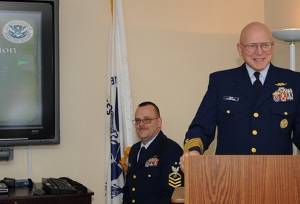
Vice Adm. Robert J. Papp speaks at a ceremony to mark the shutting down of the LORAN-C signal at the Navigation Center in Alexandria, Va., Feb. 8. Both the maritime and aviation communities have used LORAN-C signals for navigation for more than 67 years. (U.S. Coast Guard photo by Petty Officer 3rd Class Victoria Bonk-Meyers)
The U.S. Coast Guard terminated broadcast of the North American Long Range Navigation-C signal at 3 p.m. Feb. 8 with the U.S. Coast Guard Navigation Center in Alexandria, Va., coordinating the shutdown.
The LORAN system began as a radio-based navigation system during World War II under a secret program to provide the Allied forces with a reliable and accurate means of navigation at sea in any weather. Receivers for aircraft were eventually developed and the LORAN system expanded to all aspects of the military. LORAN Stations were first established in the Atlantic in 1942 and then in the Pacific. The LORAN system was then used by the Army Air Forces in the bombing campaign against the Japanese homeland. The Coast Guard retained and expanded the LORAN system at the end of the war for merchant and military use.
LORAN has, as a result of technological advancements in the last 20 years, become an antiquated system no longer required by the armed forces, the transportation sector or the nation’s security interests and is used only by a small percentage of the population. Continued use of limited resources to operate LORAN-C is no longer prudent use of taxpayer funds and is not allowed under the 2010 Department of Homeland Security Appropriations Act.
The decision to cease transmission of the LORAN-C signal reflects the president’s pledge to eliminate unnecessary federal programs.