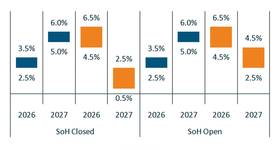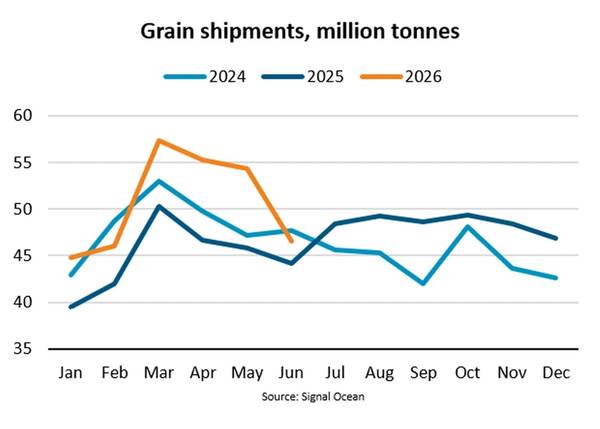
“Global grain shipments have increased 13% y/y so far this year, supported by strong wheat, maize and soya bean exports from the Americas and Europe. Improved harvests across most major exporters have boosted their export surpluses, driving higher shipments to Asia, the Middle East and North Africa,” says Filipe Gouveia, Shipping Analysis Manager at BIMCO.
Grain shipments to China have jumped 15% y/y, supported by stronger soya bean, sorghum and barley imports. An improvement in trade relations between the US and China has led to a 137% increase in US grain shipments to the country, reversing last year's weakness. Import demand for wheat, maize and soya beans has also firmed across Southeast Asia, particularly in Vietnam, Thailand and the Philippines.
Despite disruptions caused by the closure of the Strait of Hormuz, grain trade to the wider Middle East and North Africa regions has risen 18% y/y. While imports into the Persian Gulf have fallen 49% y/y, this has been partly offset by stronger shipments to Saudi ports in the Red Sea and to Fujairah.
“Higher grain volumes have primarily benefited the supramax segment, where shipments have surged 27% y/y so far this year. This has led to a 4% y/y increase in global supramax tonne mile demand, thus supporting freight rates for this segment. Without the increase in grain shipments, supramax demand would instead have stagnated,” says Gouveia.
The handysize and panamax segments have also seen grain cargoes rise 10% and 8% y/y respectively. For handysize, this increase allowed demand to remain stable despite weaker coal and minor bulk shipments in the segment. For panamax, the impact from grains was comparatively lower, amidst higher coal shipments.
Several risks persist, clouding the outlook for grain shipments. Fertilizer supply remains tight, since a weakening in Persian Gulf exports has led to an 8% y/y drop in global fertilizer shipments. Consequently, unless the Strait of Hormuz reopens soon, this could negatively impact yields in the next Southern Hemisphere harvests. In addition, high temperatures in parts of Europe and North America are jeopardising the upcoming maize harvests in September.
“Overall, the outlook for grain shipments appears weaker for the second half of 2026. According to projections by the United States Department of Agriculture, global production of wheat and maize are expected to decline slightly from last year's high levels. Furthermore, an expected increase in grain production in importing markets such as China and Türkiye could hinder import demand,” says Gouveia.