Long-distance ferry routes form a key part of Japan’s national transport infrastructure, connecting the archipelago’s four major islands and littoral centers of population, commerce and industry.
RoRo passenger (RoPax) ferry fleet renewal and development has been a constant process over the past two decades in particular, driven largely by freight demand in combination with the pursuit of cost efficiencies and in response to new legislative edicts and rising customer expectations. A cohesive Japanese approach, founded on enduring commercial ties between compatriot shipowners, builders and suppliers, continues to see construction focused on Japanese yards.
Sustained reinvestment by the companies involved has better ensured the competitiveness of the sea transport option, allied in more recent years with a national strategy of fostering a modal shift from the congested highway system to sea transport. Initially promoted by government on environmental and efficiency grounds, the move to transfer more domestic trade to the coastal seaways has assumed greater importance due to the lack of truck drivers.
In addition, and relative to the rather utilitarian nature of their forebears’ interior design, new-generation vessels reflect greater consideration of onboard standards for passengers --a sign of the sector’s increased patronage and scope for leisure travel rather than simply for necessary transportation.
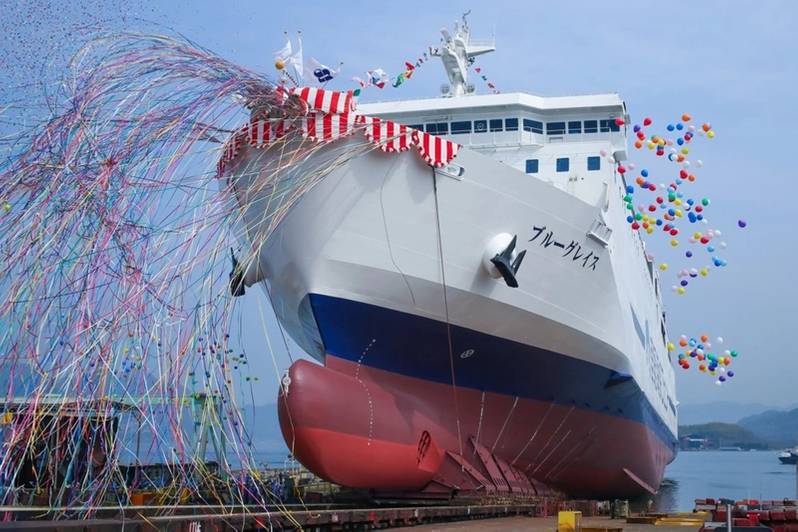 Blue Grace embodies two-stroke power for Tsugaru Strait transits in northern Japan. Image courtesy Naikai Zosen
Home-Grown Tonnage
The fact that fleet renewal and development remains concentrated on Japanese shipyards highlights the industry’s capacity to demonstrate resilience in target fields through a discipline of continuous improvement in design and productivity. Mitsubishi Shipbuilding’s Enoura plant at Shimonoseki, at the westernmost end of the Seto Inland Sea, is a consistently leading force in large ferry construction. Naikai Zosen’s Setoda yard near Innoshima is also increasingly prominent in the sector
Setting a new benchmark in efficiency and comfort among Japan’s fleet of long-haul, coastal ro-pax ferries, the 14,157 gt Keyaki made her debut in November on the route linking Otaru, on the northernmost island of Hokkaido, with Maizuru, in the Kyoto Prefecture of central Honshu.
As the first of a pair jointly contracted from Mitsubishi by Shin Nihonkai Ferry Co and Japan Railway Construction, Transport & Technology Agency (JRTT), the 199-metre Keyaki incorporates a raft of measures promising a 5% cut in energy consumption relative to her predecessors.
Keyaki is the ninth vessel built by Mitsubishi under contract to Shin Nihonkai, and the collaboration is scheduled to yield the 10th ferry during mid 2026, the sistership Hamanasu. In each case, ro/ro intake corresponds to some 150 trucks plus 30 cars, or equivalent mix, with provision for 286 passengers in a broader range of berths than has hitherto been available on the 21-hour passage.
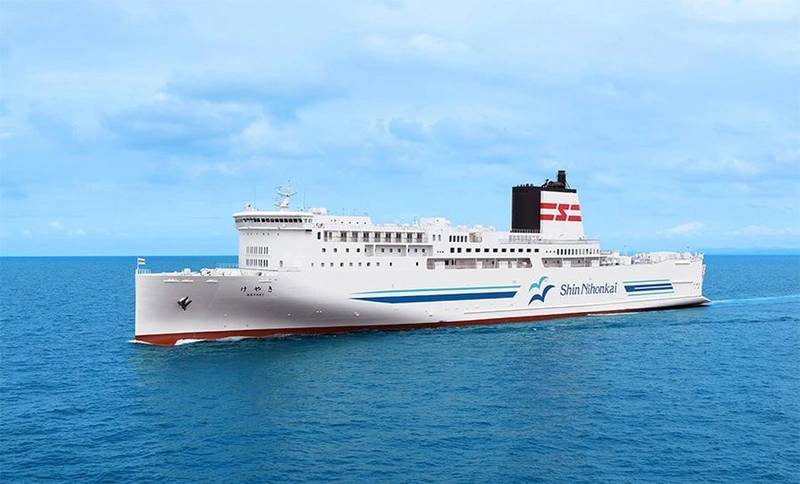 28-knot Keyaki sets a new benchmark in efficiency on a long-distance Sea of Japan route.
Image courtesy Mitsubishi
Fleet Milestones
Viewed as ‘milestone’ vessels in the context of a distinct market segment largely on the grounds of operational economy, the 28-knot newbuilds will supersede two nonetheless more technologically complex, and still faster ships dating from 2004.
The 224-metre Akashia and current Hamanasu commissioned two decades ago by Shin Nihonkai from Mitsubishi’s Nagasaki yard, and now due to be displaced by the newbuild duo, were remarkable vessels from a technological standpoint. They are distinguished by a hybrid diesel-mechanical/diesel-electric propulsion arrangement and capability for a 31-knot service speed.
However, the incoming ships signify an altogether more pragmatic approach. Rather than replicating the previous generation’s status as a master class in marine engineering, the new Keyaki and follow-on Hamanasu embody an efficiency-led strategy that blends a four-engine, diesel-mechanical driveline solution with an optimised hull form featuring a Katana Bow and buttock-flow sternship with a ducktail. Propulsion resistance, speed keeping in adverse conditions, and onboard habitability and comfort are enhanced by an anti-roll tank and fin stabilizers.
Together with the power concentration and speed scale-down to 34,160 kW and 28 knots, respectively, and adoption of the Wartsila 31-series medium-speed engine platform, the vessels are forecast to not only yield a 5% energy saving, but also through-life reductions in maintenance compared with the outgoing generation’s complex, expensive powering and propulsion solution. The primary power plant consists of four 14-cylinder vee-type examples of the W31 engine family, as chosen in recent years by a number of other Japanese ferry operators.
 MOL's dual-fuel ro/pax Sunflower Pirka has a carbon footprint 35% lower than that of her predecessor.
Two-Stroke Uptake
Traditionally the province of powerful medium-speed machinery, notably the Pielstick marque, and now with more recent penetration by Wartsila, the sector has also witnessed increased nomination of two-stroke propulsion.
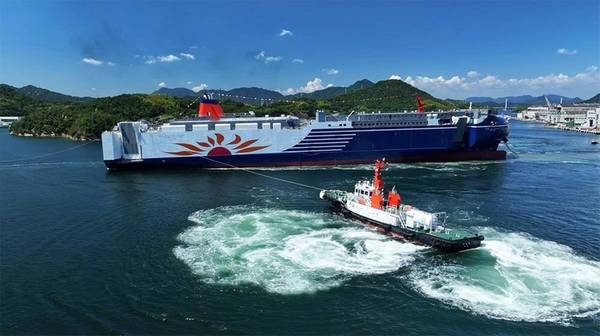
A case in point is the latest fleet project of Mitsui OSK Lines’ subsidiary MOL Sunflower, which specified an MAN dual-fuel, low-speed main engine for each of two 199-metre ro-pax newbuilds booked with Naikai Zosen. First-of-class Sunflower Kamuy was phased into service in January 2025, linking the Hokkaido port of Tomakomai with Oarai, northeast of the Tokyo metropolis, followed by sister vessel Sunflower Pirka during June.
As well as virtually eliminating SOx emissions, regular ingestion of LNG by the single MAN 12-cylinder S50ME-C8.5-GI two-stroke engine will contribute 25% to the prospective, overall 35% diminution in CO2. Produced by licensee Mitsui E&S, the 21,240 kW installation meets the service speed requirement of approximately 24 knots.
Efficiency promoting elements include a streamlined hull shape featuring a fo’c’sle windshield and aerodynamically-rounded bow form, and the attachment on both sides of the bow above the waterline of a rectangular device known as a spray tearing plate (STP), to reduce wave-induced resistance.
The new vessels’ principal role on the dedicated service is freight transportation, catered for by a 155-truck intake, to shift fresh produce southbound to the densely populated Tokyo/Yokohama region, and return northbound with mixed goods. Each ship also has 157 passenger berths, expected to be most regularly used by truck drivers and business travellers.
Naikai Zosen’s 2025 output from its Setoda yard also encompassed the 144-metre Blue Grace, commissioned by Tsugaru Kaikyo Ferry for the seven-hour Muroran/Aomori route connecting Hokkaido with northern Honshu. Powered by an MAN low-speed 6S50ME-C main engine of 8,300 kW, Blue Grace can load 64 x 12-metre trucks and 30 cars, and has capacity for 422 passengers.
The new ship’s arrival has led to the release by Tsugaru Kaikyo of its 2020-built Blue Luminous for a logistic role with Japan’s Ministry of Defense, to enable rapid deployment of troops and equipment to remote parts of the country in the event of an emergency or disaster. Likewise, Shin Nihonkai’s current Hamanasu, in the aftermath of the delivery of the newbuild Keyaki, has also been engaged for sealift duties.
There are indications that the sealift fleet may be expanded from two up to eight ro/ro equipped vessels over the coming years, reportedly in the light of increased regional tensions.
 Vee-form models of Wärtsilä's 31 engine platform have found favour in the Japanese ro/ro ferry market.
Image courtesy Wärtsilä