“Deliveries of new container ships during the first seven months of the year reached a new record high of 1.2 million TEU in 2023, beating the previous record by 0.2 million TEU. As recycling of ships has remained low, the fleet capacity has grown 4.3% since January,” says Niels Rasmussen, Chief Shipping Analyst at BIMCO.
The contracting of new ships has slowed since its record in 2021 but has year-to-date remained twice as high as during the 2010s. The 1.3 million TEU contracted so far this year has therefore kept the order book high, only 3,000 TEU short of the record 7.6 million TEU reached in March 2023.
The order book is in fact so large that ship deliveries are expected to exceed the previous full-year record of 1.7 million TEU three years in a row. Based on current estimated delivery dates, a total of 2.4, 2.9, and 1.9 million TEU are expected to be delivered in 2023, 2024 and 2025 respectively.
Recycling of ships is also expected to increase in the coming years. More energy efficient ships will replace less efficient ones as owners aim to reduce greenhouse gas emissions.
“Despite recycling of older ships, the fleet is still expected to grow by approximately 4.5 million TEU between early 2023 and early 2025, increasing the fleet capacity by nearly 18%,” says Rasmussen.
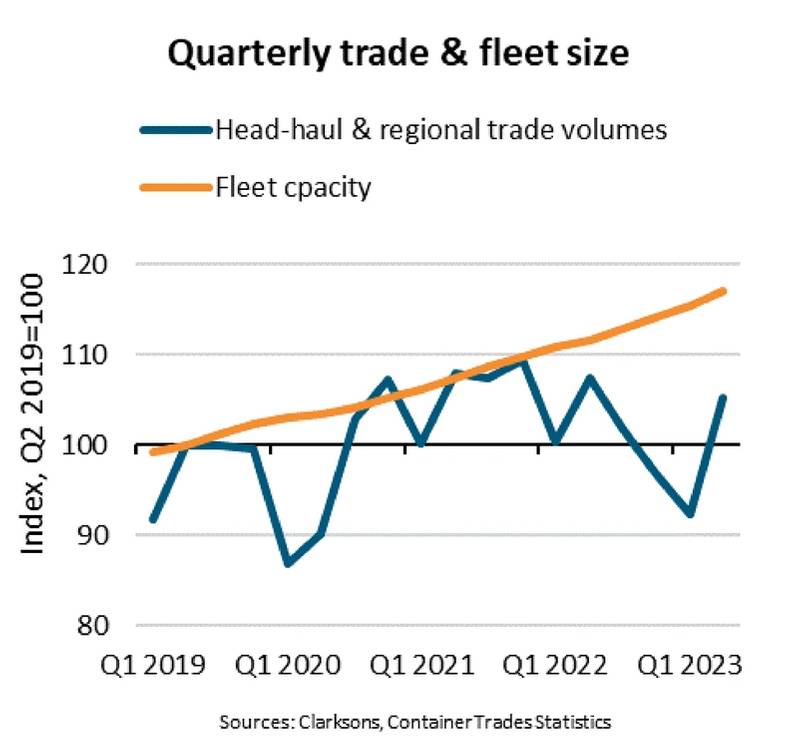
The increase in fleet capacity comes at a time when current trade growth in many key regions is declining and global economy growth prospects for the coming years are weakening.
According to Container Trades Statistics, total global container volumes during the first half of 2023 fell 4.3% year-on-year and ended only 0.2% higher than during the first half of 2019. The all-important head-haul and regional trade lanes fell a combined 4.9% year-on-year but remained 3.1% higher than during the first half of 2019.
Fortunately, the head-haul and regional trade lanes improved in the second quarter as volumes fell 2.0% year-on-year and were 5.3% higher than in 2019.
“Highlighting the current time charter and freight rate market weakness, head-haul and regional trade volumes have grown 5.3% compared to Q2 2019 while fleet capacity has grown 17%. Future supply growth may be tempered by reduced sailing speeds but further fleet capacity growth of about 15% in the coming year and a half underlines how supply side growth will remain a challenge for ship owners and operators,” says Rasmussen.