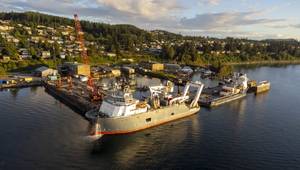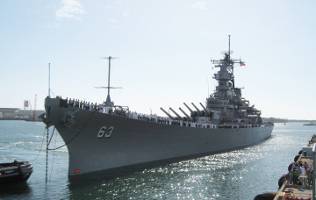
One of the most illustrious warships in the history of United States Navy has been preserved for the future with a Cathelco hull corrosion protection system. The USS Missouri served in some of the most famous naval conflicts of the 20th century and is best known as the site of Japan’s surrender in 1945 which ended World War II. After war time service in the South Pacific, Korea and more recently providing fire support during Operation Desert Storm in the Persian Gulf, the warship was decommissioned and donated to the USS Missouri Memorial Association in 1998. This January, after refitting work in Hawaii, the USS Missouri returned to her permanent berth in Pearl Harbour where she will attract thousands of visitors a year as a museum ship.
When the USS Missouri was originally built with a top speed of 33 knots, the hull was protected against corrosion with an impressed current cathodic protection system (ICCP) system consisting of ten anodes and several reference electrodes.
“We were originally contacted before the USS Missouri was scheduled for dry dock at the BAE Systems Hawaii Shipyard to simply replace the existing control panels,” said Harry Coulombe, Marine Sales Representative of Farwest Corrosion Control Co., Cathelco’s agent for the Western United States.
“However, after review of the current system, we proposed to install a new ICCP system with Cathelco diver changeable hull components that would ensure its effectiveness until the next scheduled dry dock in 20 years time. The Missouri’s engineers were very pleased to have the assurance that they would not have to dry dock if a hull component needed to be replaced. The new digital, state-of-the-art control panels, would also be more effective in combating hull corrosion over the coming decades,” Coulombe explained.
“Naval vessels operating at high speed require ICCP systems which are capable of neutralizing the corrosive activity on the hull caused by turbulence created by the propellers and as the ship passes through the water. Obviously, the requirements for a permanently moored vessel are very different,” said Aneel Mumtaz, a corrosion engineer at Cathelco’s headquarters in Chesterfield, United Kingdom.
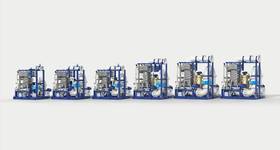
The new Cathelco equipment has the advantage of using the latest ICCP technology providing greater effectiveness, whilst reducing the number of anodes and hull penetrations. The forward system has involved the installation of a 100amp thyristor control panel which is wired to two 50 amp linear loop anodes and reference electrodes mounted port and starboard on the hull. The advantage of linear loop anodes is that they emit a relatively high output from a small surface area, therefore fewer are required to achieve the necessary protection levels.
The more powerful aft system consists of a 300 amp control panel, two 150 amp anodes and reference electrodes. All of the anodes and reference electrodes are designed to be diver changeable and can be replaced in future, if necessary, without the need for drydocking.
(www.cathelco.com)