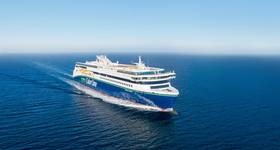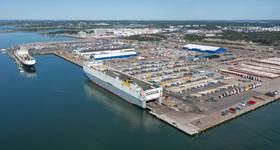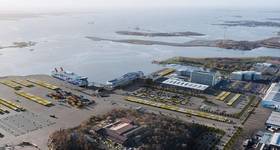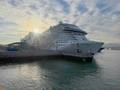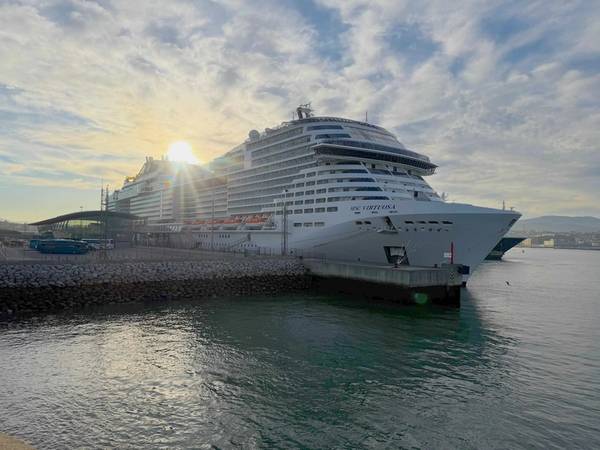
The Port of Bilbao’s latest cruise season has set a new record. From the arrival of the first ship on February 25 until the call of the last two today, 104 ships (nine more than last year) have visited the Getxo cruise terminal, carrying a total of 233,236 cruise passengers (+29% on 2025).
The Port of Bilbao has also shown versatility, welcoming ships of different sizes and adapting to their specific needs. The ships that berthed ranged from 104 to 344 meters in length. In total, 31 cruise lines chose the Port of Bilbao for their calls, 11 of them for the first time.
Over the course of 2026, nine ships stayed overnight and three began and ended their voyage in Getxo: Hapag-Lloyd’s (TUI) Europa 2, and Oceania Cruises’ Nautica and Maria.
The terminal also handled simultaneous calls. On six days, three ships called at the same time, and on August 30, the embarkation and disembarkation of the Nautica was added. Around half of the passengers came from the United Kingdom, followed by German and American passengers.
Economic Footprint
Cruise tourism leaves a notable economic footprint on the region. According to the methodology of Puertos del Estado, the Spanish state ports agency, each cruise passenger generates around USD$162.6 (146 euros) of economic impact, combining their spending on food and drink, shopping, transport and cultural activities with the knock-on effect of that spending on suppliers and wages.
Applied to this season’s 233,236 cruise passengers, this estimate represents an economic impact of around USD$37.8 million (34 million euros) in Bilbao, Getxo and the rest of the Basque Country, supporting some 280 jobs, most of them in hospitality and retail. This can also be added to the impact of the crews, who also go ashore: an additional USD$12.26 million (11 million euros). Over the last five years (2022-2026), more than 800,000 cruise passengers have generated an economic impact of close to USD$133.7 million (120 million euros) in the region.
Social Impact
The growth in cruise tourism does not translate into overcrowding. With around 0.10 cruise passengers per inhabitant in 2026, one for every ten residents of the Basque Country, Bilbao remains one of the cruise destinations with the lowest tourism pressure in Spain. According to the latest comparable data from Puertos del Estado, for 2025, the average for Spain’s main cruise ports was 0.57 cruise passengers per inhabitant, and 0.22 excluding the Balearic Islands, the Canary Islands and Barcelona, compared with 0.08 in the Basque Country.
Cruise passengers also account for only a small share of the tourists visiting the Basque Country: in 2025 they were equivalent to less than 5% of the 3.9 million guests staying in its hotels, according to Eustat, the Basque statistics institute. Their visits are organized and predictable, concentrated in a few hours and spread between Bilbao, Getxo and other destinations in the Basque Country, without taking up accommodation.
Environmental Sustainability
As part of its energy transition plan, the Port Authority of Bilbao is continuing work on the deployment of the Onshore Power Supply (OPS) system, which will allow cruise ships to connect to the onshore electricity grid while in port, switching off their auxiliary engines and reducing emissions, noise and vibration. The energy supplied to ships will be 100% certified renewable, from the port’s own photovoltaic installation and from electricity with guarantees of origin. The service will be available at the end of 2027, and the investment is co-financed by the European Commission through the Connecting Europe Facility (CEF) program, the Recovery, Transformation and Resilience Plan – NextGenerationEU, and the European Investment Bank (EIB).
Thanks to OPS, the CO2 emissions of each call will fall by at least 85%, and those of nitrogen oxides, sulphur oxides and particulate matter by around 95%. Cruise passengers will thus become the visitors who emit the least CO2 during their stay: according to Port Authority estimates, each passenger will emit 25% less CO2 in the region than someone arriving by train, 40% less than by coach, 71% less than by car and 78% less than each air passenger during landing and take-off.