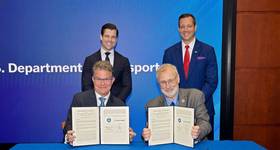
The Bureau of Safety and Environmental Enforcement (BSEE) and The National Aeronautics and Space Administration (NASA) have announced a five-year agreement allowing BSEE to capitalize on the best risk management approaches from the aeronautics industry to inform stakeholders and further strengthen worker and environmental safety protections on the Outer Continental Shelf.
“Both BSEE and NASA work in harsh and uncompromising environments, relying on cutting edge technology to go deeper and further than previously thought possible,” said BSEE Director Brian Salerno. “This partnership brings together technical experts from BSEE and NASA to focus on the specific risks associated with offshore operations so that we can continue to find ways to improve safety for offshore workers and protect the environment.”
Under the agreement, NASA will assist BSEE in achieving three primary objectives:
• further develop BSEE's risk management capability through the use of NASA's probabilistic risk assessment technique;
• evaluate, design, and test technologies and hardware, including emerging technologies and best available and safest technologies; and
• assess failures and near miss occurrences using the resources and expertise of NASA's accredited failure analysis laboratory at the Johnson Space Center in Houston.
Used by NASA, probabilistic risk assessment is a technique to quantitatively model risk. It was used in the modeling of the Space Shuttle Program and is presently being used for the International Space Station and Orion deep space capsule programs.
“Whether the task takes one to deep space, or into the deep ocean, the analysis of the environment, training of personnel and risk mitigation factors are similar,” said Jack James, technology transfer strategist at the Johnson Space Center. “NASA is pleased to work with BSEE, and we endeavor to learn best practices from each other.”