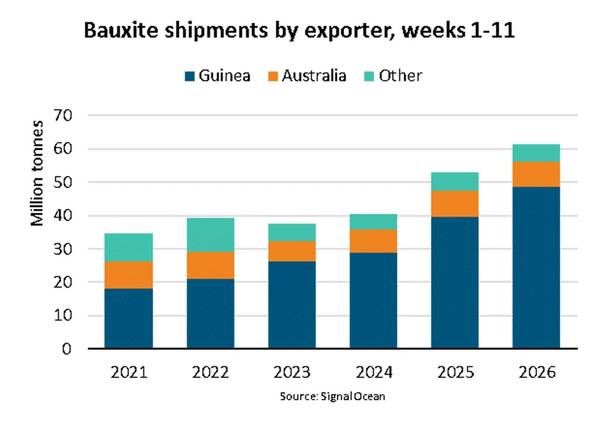
"During the first 11 weeks of 2026, bauxite shipments have surged 16% y/y, driven by strong Chinese demand for Guinean cargoes. Guinean bauxite has remained highly competitive, accounting for 79% of shipments and pushing non-Guinean bauxite shipments down 3% y/y. Bauxite has been one of the fastest growing dry bulk commodities, growing 10% on average between 2021 and 2025,” says Filipe Gouveia, Shipping Analysis Manager at BIMCO.
Rising bauxite shipments are driven by China’s need to replace its depleting domestic reserves and by a 3% y/y increase in Chinese aluminium production during the first two months of 2026. China is the destination for 88% of global bauxite shipments and is the world’s largest aluminium producer, accounting for 65% of global output. Bauxite is the main raw material used to produce alumina which is then refined into aluminium.
“Since the capesize segment carries 79% of bauxite cargoes, it has been the major beneficiary of rising shipments, contributing to a 121% y/y surge in the Baltic Exchange’s capesize index so far this year. Bauxite shipments on capesizes have risen 25% y/y which, paired with bauxite’s above average sailing distances, have contributed to higher tonne mile demand. Consequently, bauxite now accounts for around one fifth of the segment’s tonne mile demand, making it the second largest commodity,” says Gouveia.
The outlook for bauxite shipments appears broadly positive, supported by growing global demand for aluminium and depleting bauxite reserves in China. However, several factors could reshape the trade in coming years.
At the end of 2025, China’s aluminium production reached its government mandated cap of 45m tonnes per year. This limit was originally set in 2017 to limit oversupply, electricity demand, and environmental impacts. If this cap is enforced, aluminium production would stagnate, slowing down bauxite demand growth. Guinea’s push to expand domestic alumina refining could also limit shipments. In the medium-term, however, the impact is expected to be limited with only one refinery under construction.
More immediate risks stem from unfolding geopolitical and market developments. Disruptions in the Persian Gulf have impacted regional aluminium exports which could lead importers to seek alternative suppliers such as China. However, aluminium and energy prices have increased, which could negatively impact demand since aluminium production is energy intensive.
“A potentially disruptive development is emerging in Guinea itself. The government is actively considering introducing bauxite export quotas to strengthen prices. While no decision has been taken, the introduction of quotas could disrupt global bauxite supply and negatively impact the capesize segment,” says Gouveia.