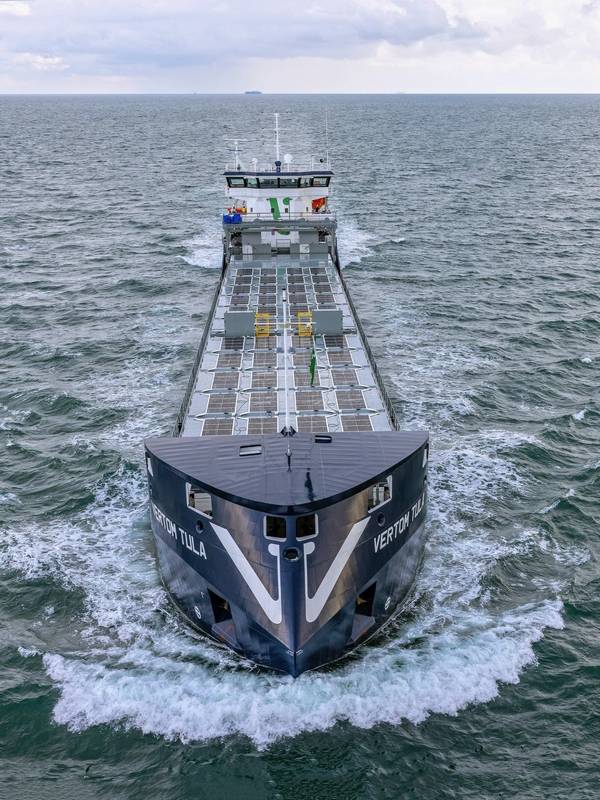
Following successful pilot projects and the first full-scale installation on a seagoing vessel, the Vertom Tula, Wattlab is now taking the next step: scaling its Solar Flatrack solution towards the international bulk shipping market.
Currently, Solar Flatracks can be deployed on vessels up to and including the Supramax segment. In parallel, Wattlab has started the development of seaworthy solar solutions for Panamax and even Capesize bulk carriers.
Wattlab, a specialist in solar power for shipping, has demonstrated through the successful application of its Solar Flatrack system on seagoing vessels that solar energy can be a practical and scalable part of onboard energy supply - particularly for the vessel’s hotel load.
After two pilot projects and a first full-scale installation on a coaster, the results confirm that the system performs reliably at sea and directly contributes to fuel savings and emission reductions.
In collaboration with TNO and shipping company Vertom, the system was tested on the Vertom Anette. The insights gained were subsequently applied to the Vertom Tula, where 44 Solar Flatracks reduce approximately 20% of the onboard hotel load. The project was co-financed by the European Union’s Just Transition Fund (JTF), part of the European Green Deal towards climate neutrality by 2050.
“With this step, we show that solar power at sea is no longer an experiment, but a working solution,” says Bo Salet, CEO and co-founder of Wattlab.
“Through the two pilot projects, we learned a great deal about usability - both from a technical perspective and in terms of how easily the crew can operate the system. We also gained valuable insights into seaworthiness. Based on this knowledge, we have significantly upgraded our Solar Flatrack system.”
A key concern for shipowners is the impact on day-to-day operations, particularly when carrying deck cargo. The Solar Flatrack system has been designed to ensure that:
• panels can remain in place during loading and unloading
• the system can be easily disconnected and stacked if required
• units can be compactly stored within the footprint of a single 20-foot container
As a result, the vessel’s operational flexibility remains fully intact.
With its current technology, Wattlab can deploy solar energy systems on coasters and vessels up to the Supramax segment - particularly on ships equipped with foldable or stackable hatch covers. Based on these results, development has now started to serve larger vessel classes, including Panamax and bigger bulk carrier types.
Salet said: “Market interest is growing rapidly. We have already engaged with more than 200 international parties interested in applying Solar Flatracks across their fleets.”
By reducing fuel consumption, solar energy directly contributes to lower CO₂ emissions and improved performance on key indicators such as CII and EEXI. It also supports compliance with European regulations, including FuelEU Maritime and the EU ETS. In addition, Solar Flatracks reduce shipowners’ dependence on volatile fuel prices.
With an expected return on investment of 3-5 years, Wattlab considers the system a financially viable solution for decarbonizing both existing and new vessels.