"Geopolitical disruptions continue to cloud the dry bulk market outlook. The effective closure of the Strait of Hormuz remains the largest source of uncertainty, while attacks on ships and port infrastructure in the Black Sea have added another layer of risk,” says Filipe Gouveia, Shipping Analysis Manager at BIMCO.
Typically, around 4% of dry bulk demand sails via the Strait of Hormuz. Alternative routes have softened the impact of the disruption but have been unable to replace pre-war volumes. The disruption has also tightened energy and fertiliser supplies, weighing on global economic growth and raising concerns over food security.
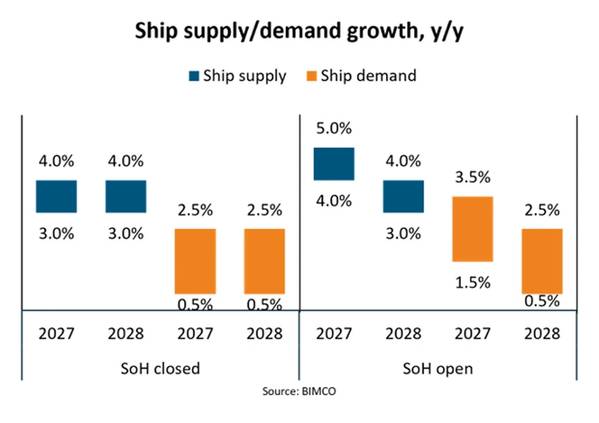
Given the uncertainty, BIMCO presents two forecast scenarios. The “SoH closed” scenario assumes that the strait remains effectively closed throughout 2027 and 2028, while the “SoH open” scenario assumes that ships can freely transit the strait from 2027 onwards.
“We expect the dry bulk supply/demand balance to gradually weaken in 2027 and 2028, although from a high baseline. Cargo volume growth is expected to be limited, while ship deliveries accelerate, particularly in the capesize segment,” says Gouveia.
In 2027, ship demand is forecast to grow 0.5-2.5% if the Strait of Hormuz remains effectively closed, compared with supply growth of 3-4%. If the strait reopens, both demand and supply growth are expected to be 1 percentage point higher. In this scenario, demand would grow faster for commodities other than coal supported by improved economic conditions and stronger import demand from countries in the Persian Gulf. However, the fleet currently trapped in the Gulf would begin operating as normal and sailing speeds could remain slightly higher than in our other scenario, increasing supply.
In 2028, ship demand is forecast to grow 0.5-2.5% in both scenarios, while supply is expected to grow 3-4%. Cargo volume growth is expected to remain limited as coal shipments decline, while the return of bulkers to the Panama Canal could weigh on average sailing distance growth. On the supply side, rising ship deliveries are expected to support strong fleet growth, even as ship recycling increases. Lastly, average sailing speeds are expected to decrease slightly as market conditions soften.
“Disruptions to Black Sea shipping pose an additional downside risk to the market outlook. The forecast assumes that Russian and Ukrainian grain volumes unable to be shipped in 2026 are instead exported in 2027. If they remain unavailable, dry bulk cargo growth could be up to 0.5 percentage points weaker in 2027 and grain shipment growth up to 4 percentage points weaker,” says Gouveia.