Register now for the Port of the Future Conference • 2 Days, 50 Ports • Houston/Galveston area, TX • April 12–14, 2027

Victoria International Container Terminal Expands Crane Fleet

August 21, 2023

Source: ICTSI
Source: ICTSI

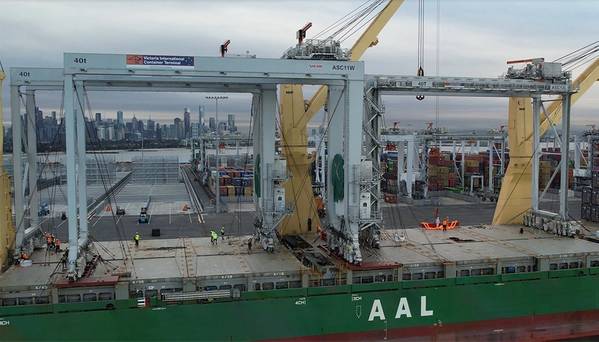
Victoria International Container Terminal (VICT) at the Port of Melbourne, Australia’s first fully automated container terminal, is expanding its equipment fleet with the addition of six new automated stacking cranes (ASC).

Purchased as part of VICT’s ongoing expansion project, the new ASCs will operate on three new yard modules to increase the terminal’s yard and reefer capacity by 30% and 43%, respectively. 15 additional truck grids will also be added to increase slot availability by 30%.

VICT is also acquiring two new larger ship-to-shore (STS) cranes, bringing total STS fleet to seven. The new cranes will have an outreach of 22 containers to enable the handling of up to 14,000-TEU capacity Neo-Panamax ships. Moreover, the quay line will be extended by 71 meters to allow two 336-meter-long vessels to berth simultaneously.

VICT’s expansion is scheduled to be completed and operational by the start of 2024 and will raise VICT’s annual throughput capacity by 250,000 TEUs to 1.25 million TEUs.

Logistics News

La Spezia Container Terminal Signs Contracts for Ship-to-Shore, Yard Cranes

La Spezia Container Terminal Signs Contracts for Ship-to-Shore, Yard Cranes

Hormuz Crisis Accelerates Gulf Pipeline and Port Expansion

Hormuz Crisis Accelerates Gulf Pipeline and Port Expansion

Encomara Squid Connection System Qualifies for Commercialization

Encomara Squid Connection System Qualifies for Commercialization

Russia Focuses Strikes on Ukrainian Ports, Industrial Sites, Distribution Facilities

Russia Focuses Strikes on Ukrainian Ports, Industrial Sites, Distribution Facilities

Subscribe for Maritime Logistics Professional E‑News

New York Times Business News - August 28, 2018
After drone attacks, Russian oil exports from Novorossiysk will more than halve by August
Air New Zealand records its biggest loss since 2023 due to fuel and engine costs