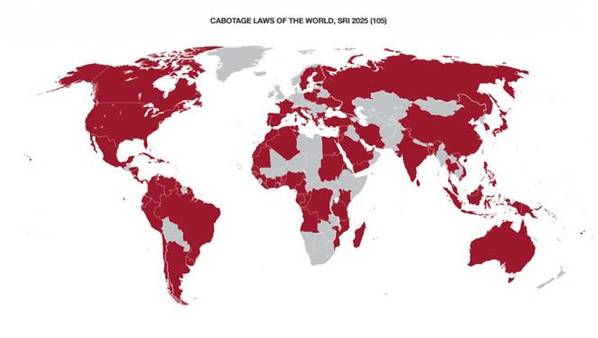
A newly released study by Seafarers' Rights International (SRI) finds that cabotage laws now exist on 85% of the world’s coastlines, are growing in number at an unprecedented pace, and are increasingly essential to national security, economic stability and maritime resilience.
The Cabotage Laws of the World (2025) report, commissioned by the International Transport Workers' Federation (ITF), compares nations in their enforcement of cabotage laws, which restrict the waterborne transportation of goods or passengers between two points within the same country to domestic carriers. This ensures that critical services remain reliable within a country in times of crisis.
The number of countries with cabotage laws has increased from 91 in 2018, when the report was last conducted, to 105 in 2025. While changes between 2018 and 2025 were expected, according to the report, “cabotage laws were found to have spread around the world faster than ever before in the centuries-long history of cabotage.”
“Countries appear no longer to be viewing cabotage as merely economic policy, but also as essential to national security and strategic autonomy in an increasingly unstable geopolitical environment,” said Deirdre Fitzpatrick, co-author of the report and Executive Director of SRI. “These 105 nations represent a remarkably diverse group controlling 85% of the global coastline.”
For the United States, maritime cabotage is governed by the Jones Act, a cornerstone law passed in 1920 that ensures America’s domestic shipping is strengthened by requiring vessels transporting cargo between U.S. ports to be U.S.-built, U.S.-owned, U.S.-flagged and U.S.-crewed. Similar laws exist for airplanes, trains and trucks transporting cargo in the country.
The Jones Act supports an estimated 650,000 jobs and contributes $150 billion to the U.S. economy annually. This law also contributes to the strategic sealift capacity needed for America’s armed forces.
As the international community increasingly turns toward cabotage to safeguard its maritime sectors and “contest the emergence of the new global geopolitical order,” according to study authors, the United States stands as a model, with approximately 40,000 vessels in the Jones Act fleet.
Additional nations with strong cabotage laws similar to the United States’ Jones Act include South Korea, Japan, Israel, Brazil, Turkey and even China, among many other nations.