The Austrian livestock dealer allegedly responsible for the weeks of livestock suffering and death on the Spiridon II is to appear before the Krems Regional Court in Austria on Friday as part of a civil lawsuit. The importers of the animals accuse him of fraud.
The cattle from Uruguay—half of which were pregnant heifers—were originally destined for Turkey. Upon arrival, however, they were not allowed to be unloaded from Spiridon II because, according to the authorities, nearly 500 of them were not listed on the import list. The Turkish importers attempted to secure their unloading through legal action, but the Turkish court rejected the request.
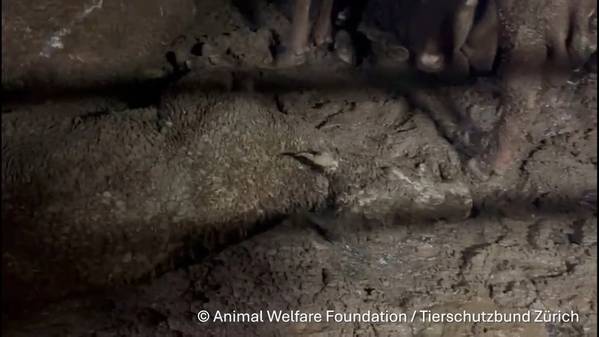
Meanwhile, conditions on board were growing increasingly dire: more and more animals were dying, and more and more were giving birth to their calves in knee-deep mud. White sacks were piling up on board. In photos, an animal leg appeared to be sticking out of one of one of them. The strong smell of decay and manure, which even led to protests among the residents of Bandirma, also suggests that animal remains were being stored on board.
After nearly four weeks off the Turkish coast, the ship finally turned back, then turned off its tracking system for several days, and eventually unloaded the surviving animals in the Libyan city of Benghazi. Upon arrival, the white sacks on the upper deck had disappeared, suggesting that dead animals were dumped into the Mediterranean during the radio silence.
The circumstances were investigated and reported by Animal Welfare Foundation and The Marker.
The importers hold Christian Klinger, a livestock dealer from the Waldviertel region, and his company, Agro Breeding, responsible for the events. According to the importers, Klinger organized the transport and arranged for the loading of animals not listed on the import manifest. Furthermore, he allegedly delayed the ship’s departure, originally scheduled for July, by approximately two months for unknown reasons. As a result, many of the cattle were no longer fit for transport because their pregnancies were already too far along.
Furthermore, the importers accuse the livestock dealer of denying a veterinarian hired by them access to the ship during loading in Uruguay and of preventing the importers from checking the animals with an ear tag reader as they boarded the ship.
The importers claim that they had already made an upfront investment and were therefore unable to back out of the deal. They hold the livestock dealer responsible for the failed import, the suffering of the animals, and the resulting economic losses. As an experienced businessman with a proven track record of familiarity with import and processing procedures in Turkey, he should have been aware of the risks involved in such a transport.
Now the Krems Regional Court must determine whether the fraud charges brought against him are justified.
Animal rights activists see a systemic problem: “Live animal transport is extremely stressful for animals—even when everything goes according to plan: constant stress from rough seas, extreme crowding, inadequate care, injuries, and deaths are inherent to the system. When this is accompanied by deliberately accepted risks, such as loading unregistered animals, massive animal suffering is inevitable,” says Maria Boada Saña, veterinarian and project manager for ship transport at the Animal Welfare Foundation.
“Thousands of cattle are also exported from Austria by ship to third countries every year, particularly to Algeria. The accused company has organized such exports from Austria itself in the past. Across the EU, around 3 million animals are exported by ship each year—and serious incidents in which animals suffer or die occur time and again. The tragedy involving the Spiridon II is by no means an isolated case and clearly demonstrates that a ban on the transport of live animals by sea is needed,” adds Ann-Kathrin Freude of The Marker.