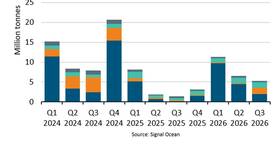
Russia could double gasoline exports in coming years due to a leap in its refining capacity and a falloff in domestic demand, which could worsen a fuel overhang in Europe, according to experts and Reuters calculations.
Russian gasoline exports jumped by more than 15 percent last year to 3.35 million tonnes thanks to a $50 billion modernisation programme which Russian refineries began in 2011 in response to domestic gasoline shortages.
That growth followed a 1.3 percent decline in Russian domestic consumption of gasoline in 2015, the first such fall since the early 2000s.
Weak demand for cars points to a decline of almost 4 percent this year in domestic demand for the fuel, according to Moscow-based think-tank Vygon Consulting, which expects gasoline exports to surge to over 9 million tonnes annually in 2017-2018.
Ekaterina Grushevenko, an expert at the Moscow-based SKOLKOVO Business School Energy Centre, sees exports rising to 7 to 8 million tonnes in 2018.
"There are two key reasons behind the rise in gasoline exports: decline in domestic demand for gasoline and an increase in fuel production in Russia," she said, adding that she expects gasoline output to rise to 43 million tonnes in 2018.
According to Reuters calculations, Russia's high-octane gasoline production capacity will rise by 3.95 million tonnes by the end of this year to over 50 million tonnes, with the bulk of the new output intended for export.
With upgrades at existing gasoline-producing units, new annual capacity may total 4.5 million tonnes.
Russia has pledged to cut production, but not exports, of oil and oil products, as part of a deal with the Organization of the Petroleum Exporting Countries aimed at supporting oil prices.
Russia's government has not officially disclosed its oil product export plans.
Five Russian refineries are expected to finish upgrades of their gasoline production units this year.
Russian refineries produced a total of 38.3 million tonnes of high-octane gasoline last year, of which almost 35 million tonnes were consumed domestically, while the remainder was exported.
The modernisation of Russian refineries, some of which were built in 1920s and 1930s, led to a reduction in output of low-grade fuels, such as fuel oil, and an increase in production of high-grade fuels, such as gasoline.
Tax changes, particularly to export duty for fuel oil, made production of poor-quality products less profitable.
According to companies' plans, the Kirishi refinery owned by Surgutneftegaz will account for half of the new gasoline production capacity this year, potentially increasing a glut of gasoline in Europe.
The plant, the closest to Russia's western border, will commission isomerisation and reforming units in the first quarter with an annual capacity of 1.1 million tonnes and 1.2 million tonnes respectively.
(By Maxim Nazarov and Vladimir Soldatkin)