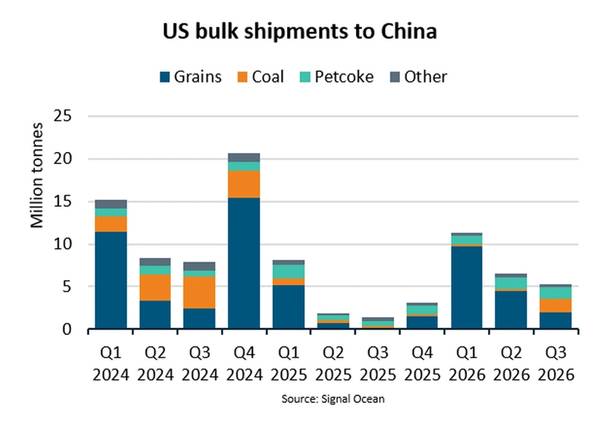
"During the first three quarters of 2026, US dry bulk shipments to China have grown 104% y/y, driven by a 176% y/y increase in the shipment of grains. Volumes between the two countries weakened in 2025 amid rising trade tensions and higher tariffs. However, an agreement reached in November 2025 lowered tariffs on US grains and set import targets for US soya beans, allowing shipments to partly recover in 2026,” says Filipe Gouveia, Shipping Analysis Manager at BIMCO.
US coal and petcoke shipments to China have also strengthened so far this year, with coal up 44% y/y and petcoke up 33% y/y. Despite these improvements, coal shipments remain 77% below 2024 levels. Meanwhile, the rise in US petcoke shipments has been supported by lower shipments from Saudi Arabia to China.
The increase in shipments has been particularly positive for the panamax segment, which has transported 68% of cargo volumes from the US to China. Supramax ships have carried an additional 28%, benefitting particularly from the increase in petcoke shipments.
“As we enter the fourth quarter, US grain shipments are expected to ramp up further, as this year’s soya beans and maize crops are harvested and exported. US maize could be in especially high demand, since attacks on ships in the Black Sea have brought Ukrainian seaborne exports to a halt,” says Gouveia.
Looking ahead, US dry bulk shipments to China could continue to increase, supported by improved trade relations. The latest round of US-China negotiations resulted in an agreement to provide more favourable tariff treatment for around USD 30bn worth of goods in each direction. The timing and product-specific tariff reductions have yet to be announced. Nevertheless, China’s Ministry of Commerce said that more than 90% of the products covered would have all additional bilateral tariffs removed.
The US products covered by the agreement include coal and most grains but exclude soya beans, the largest US dry bulk export commodity to China. The products covered accounted for 16% of US dry bulk shipments to China in 2025, down from 35% in 2024.
“As a part of the trade negotiations, China has also committed to importing at least 10m tonnes of US coal in 2027 and 2028. This is expected to approximately double coal shipments between the two countries, falling just 2m tonnes short of cargo volumes in 2024. This would also support tonne-mile demand, since distances for US coal shipments to China are around four times greater than the average for Chinese coal imports,” says Gouveia.