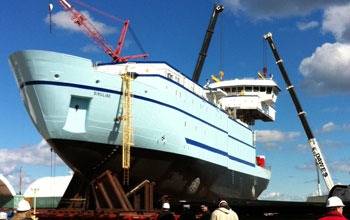
The National Science Foundation (NSF) announce launch of 'R/V Sikuliaq', a 'next-generation' global class research vessel.
The NSC new-building project was in cooperation with the Marinette Marine Corporation (MMC) and the University of Alaska, Fairbanks (UAF). MMC is the Wisconsin shipyard that built the ship with funding provided by NSF through the American Recovery and Reinvestment Act. UAF's School of Fisheries and Ocean Sciences will operate the ship as part of the U.S. academic research fleet.
"R/V Sikuliaq is one of the most advanced research vessels in the world," said NSF Director Subra Suresh. "Its capabilities to operate in extreme ecosystems will serve the science and engineering research communities for decades to come, while providing opportunities for educators and students to learn first-hand about the Arctic environment."
NSF invested nearly $200 million into R/V Sikuliaq, which was the first and largest single award made using NSF's Recovery Act funds. It is the academic fleet's first global class, ice-capable ship owned by NSF.
Although this 261-foot, general-purpose ship has a hull specifically designed to operate in Arctic sea ice and the open waters surrounding Alaska, it can work effectively throughout the world's oceans. It will support roughly 500 researchers and students annually and spend up to 270 days per year at sea. It is accessible to persons with disabilities. Sikuliaq will allow researchers to work in ice-covered waters not previously accessible on a routine basis, and play an essential role in our understanding of the Arctic Ocean system and how it is changing over time.
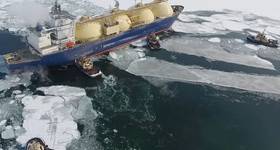
The vessel will be uniquely equipped for operating in ice-covered waters, with a reinforced double hull, two rotating thrusters, and scalloped propeller blades enabling it to break through first-year ice up to 2.5 feet thick.
Sikuliaq will depart on its first science mission in early 2014 and will be home ported at UAF's Seward Marine Center in Seward, Alaska.