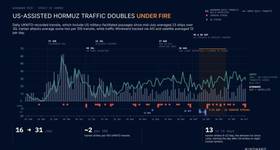
Gulf oil producers are assembling a fleet of nearly 230 tankers to maintain crude exports through the Strait of Hormuz despite heightened security risks and reluctance among independent shipowners to operate in the region, according to a weekly intelligence report from Windward Maritime dated October 29.
The report identifies five maritime developments, including changes to Gulf oil transportation, an oil spill threatening infrastructure in the United Arab Emirates, suspicious movements near subsea communications cables, continued Russian oil trading under sanctions pressure and shipping activity through the Bab el-Mandeb Strait.
Gulf states expand their tanker capacity
Windward describes the emergence of what it calls the “Arab Dark Fleet,” comprising tankers owned, managed, chartered or controlled by Gulf national oil companies and their trading and shipping affiliates. The fleet allows regional producers to move oil despite elevated freight costs and reduced availability of vessels willing to load at terminals in Iraq, Saudi Arabia, Kuwait, Bahrain, Oman and the UAE.
About 80% of the fleet consists of very large crude carriers (VLCCs). Many operate with their automatic identification systems (AIS) switched off, which Windward says reflects safety and security concerns. The vessels transport crude from terminals west of Hormuz to ship-to-ship transfer hubs off the UAE and Oman, where cargoes are transferred to other tankers for onward delivery.
Preliminary Vortexa figures cited by Windward indicate that crude exports, excluding Iranian shipments, from terminals west of Hormuz reached a pace of approximately 11 million barrels per day in October. That compares with 1.56 million barrels per day in May and prewar volumes of 14.5 million barrels per day.
The fleet expansion has tied up an estimated 15% to 20% of the global VLCC fleet at any given time, illustrating the scale of the logistical response.
Oil spill threatens UAE coastline and desalination infrastructure
An oil leak from a tanker anchored approximately 25 kilometers north of Umm Al Quwain reached UAE beaches on October 22, following a forecast issued by Windward two days earlier.
Authorities confirmed oil along the coast and closed beaches in Umm Al Quwain and Sharjah on October 23. Ras Al Khaimah closed all its beaches the following day after satellite imagery showed oil along the Al Hamra shoreline.
Windward tracked the slick northeast along the coast toward the NAQA’A desalination plant, the largest such facility in the northern emirates. The oil came close enough to the plant’s seawater intake to pose a potential operational threat. As of the report, no desalination plant had reported a shutdown. A service vessel was observed alongside the tanker, although its precise role in containing the leak or offloading cargo remained unclear.
Iranian vessels raise concerns over subsea cables
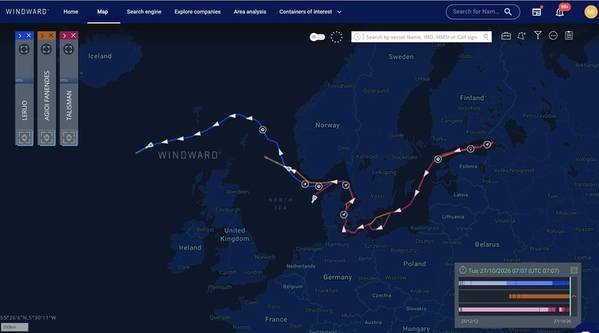
Between October 14 and 28, three U.S.-sanctioned tankers and an Iranian fishing-support vessel made unusual movements near undersea communications cable routes in the Gulf of Oman and off Iran’s Makran coast, according to Windward.
The vessels slowed, circled, reversed course or switched off AIS near several cable corridors. One tanker went dark for 86 hours near the 2Africa and Bay of Bengal Gateway routes before reappearing about nine nautical miles from its last reported position. Another turned back toward Oman after slowing near the 2Africa corridor.
The activity coincided with statements by Iranian security and military officials threatening regional undersea cables if hostilities resumed. Windward assesses that the vessel movements could indicate cable mapping or preparations for interference, but AIS data alone cannot establish whether the ships conducted surveillance or deployed equipment.
Russian oil movements continue despite sanctions
Windward also identified a Russia-flagged Aframax tanker discharging approximately 700,000 barrels of Russian ESPO crude at a terminal in Dongying, China, on October 27. The tanker had switched off its AIS signal between October 24 and 28, obscuring its port call. The vessel is sanctioned by the United States, United Kingdom and European Union.
Separately, three tankers carrying Russian diesel were reported heading toward the United States under a temporary U.S. sanctions waiver issued on October 9. Windward noted potential compliance challenges involving two of the vessels, which are themselves subject to sanctions.
Bab el-Mandeb traffic remains steady
Despite continued Houthi attacks on Saudi oil infrastructure and fighting in Yemen, vessel traffic through Bab el-Mandeb remained broadly stable. Windward recorded an average of 39 daily transits over the three-day period ending October 26, compared with approximately 35 per day since August.
Saudi-affiliated vessels were notably scarce, accounting for just 13 of roughly 2,500 crossings tracked between July 20 and October 22. Windward expects these operators to continue avoiding the strait, while other shipowners maintain current transit patterns.
Together, the developments highlight the operational adjustments, infrastructure vulnerabilities and sanctions-related complications confronting commercial shipping across the Middle East and beyond.