Copenhagen Malmo Port Begins LNG Bunkering
Aiswarya Lakshmi
June 3, 2018
Copenhagen Malmö Port (CMP) now offers bunkering of Liquefied Natural Gas (LNG). First off was the vessel Ireland, which unloaded cement in Malmö.
In connection with this she was provided with LNG via tanker lorries. It's about bunkering where safety requirements are extra tough.
The bunkering at the end of May was made possible through close cooperation between the LNG supplier SkanGas, the client company Cementa, and CMP. Together the companies have investigated risks, taken precautionary measures and developed routines for bunkering LNG at CMP.
"Ireland was provided with LNG via two tanker lorries on the quayside. The bunkering was undramatic, and it feels good for us now to be able to offer this possibility", says CMP's Terminal Manager Emil Nordström.
LNG – or liquid methane that's involved here – is an alternative fuel for ships. This fuel is becoming more common as more vessels use LNG to meet emission requirements. It also means that CMP currently receives gas-powered vessels in several of its operations.
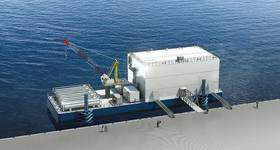
"We are now evaluating various solutions so that more types of vessels can bunker LNG with us" says Emil Nordström. "We might consider bunkering from ships, or we might invest in our own permanent LNG infrastructure in the future."
Handling LNG imposes additional safety requirements. Methane is a volatile gas at room temperature, and it is cooled down to minus 162˚C when stored or moved. A tanker lorry can carry about 40 cubic meters of LNG. Pumping the gas over to the ship takes about an hour. Before this, the gas supplier and the on-board crew go through a check-list together.
"This ensures that the technical requirements are met and that the safety measures are in place. The routines for the bunkering itself are also gone through" explains Emil Nordström.
During the course of the work a large area on the quayside is cordoned off. When bunkering is carried out the tanker is enveloped in white smoke. This is completely harmless water vapour that is formed when the gas is pumped over to the vessel.