Conoship International has expanded its CIP-Series with a fully electric version of its CIP3800 general cargo vessel, pairing the established 3,800-dwt coaster platform with a 40-MWh battery energy storage system.
Designed for short-sea routes, green shipping corridors and emission-restricted coastal operations, the CIP3800 Fully Electric measures 89.43 meters LOA with a 13.2-meter molded breadth and 5.2-meter draft.
Rather than developing a new hull specifically for battery propulsion, Conoship retained the CIP3800's existing hull geometry, which has undergone model testing, sea trials and commercial operation. Minimizing hydrodynamic resistance is particularly important for battery-powered vessels, where reducing propulsion demand directly extends operating range.
The 40-MWh battery installation provides a projected range of 350 nautical miles at 10 knots or approximately 640-650 nautical miles at 8 knots, including allowances for sea margin and hotel loads.
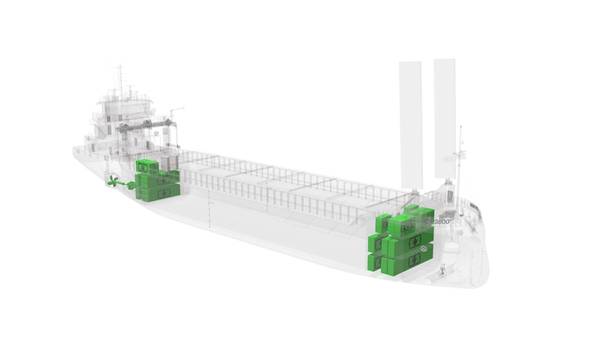
Battery capacity is divided between dedicated forward and aft compartments to maintain vessel trim without requiring additional water ballast.
Despite the battery weight, the vessel retains a 3,200-ton cargo intake at 5.20-meter draft. Conoship said weight associated with the energy storage system is substantially offset by eliminating conventional heavy fuel oil and marine gas oil storage, along with lubricating oil and sludge tanks.
Cargo capacity remains 4,737 cu. m. (167,300 cu. ft.) in a single box-shaped hold designed for general, bulk and project cargoes.
For trades where charging infrastructure remains under development, Conoship can incorporate a smaller generator set operating on fuels such as HVO or biodiesel as a range extender or backup power source.
In full-electric operation, the vessel produces zero direct CO2, NOx, SOx and particulate-matter emissions.
The electric configuration joins diesel-electric, methanol-ready and wind-assisted options available on the modular CIP3800 platform, allowing owners to select propulsion technology according to specific routes and available energy infrastructure.